"The greater danger for most of us lies not in setting our aim too high and falling short; but in setting our aim too low, and achieving our mark." -- MichelangeloThe arc of learning is long, but bends towards the bold and hard working.
Wednesday, January 1, 2014
Happy New Year and Aim High!
Best wishes to all for a happy and successful 2014! I'll share an oft used and famous quote, because I think it pertinent in our profession.


Friday, December 27, 2013
Constructing an IBL Unit: An Example Using Integers
On this blog I've written about why IBL can be a useful framework for teaching mathematics. IBL is a general framework that isn't tied to a specific curriculum or type of course. Engaging students in rich mathematical tasks is something that can be done at all levels. How instructors specifically implement IBL methods varies due to classroom conditions, and these implementations ultimately require appropriate problem sets or units. In this post the focus is on how to construct a coherent IBL unit.
In order to hit a wide audience, I've chosen a 6th grade topic, integers. The reason for this choice is that it is one of the content areas that is often memorized, but not understood conceptually. The integers are a mathematically wonderful landscape, and opportunities to explore this landscape are usually missed. Despite the choice of using integers, the core ideas are applicable broadly.
The first step is to survey the learning landscape. I'll focus on subtracting integers, which is where things get really interesting. Typical 6th grader (skill-level) tasks with integers includes subtracting positive and negative integers.
$10-6 = 4$
$4-(-8) = 12 $
$-5 - (-8) = 3$
If I ask a middle schooler (or older student/person), why this work, the vast majority of the time I get, "I don't know. It's just how I was taught to do it." To answer why questions, one needs to understand the notion of mathematical equivalence. Equivalence is a major idea that lies at the heart of the matter, not only for integers, but also in many other areas of mathematics. Equivalence shows up in the integers via the idea that every integer can be represented in infinitely many ways using zero pairs.
$$5 = 5 + (1 - 1) = 5 + (2 - 2) = 5 + (3 - 3) = \cdots$$
Written another way,
$$5 = 6 - 1 = 7 - 2 = 8 - 3 = \cdots$$
An important developmental milestone for young students is realizing that every integer can be expressed in infinitely many different, yet equivalent ways. This idea then allows students the mathematical flexibility of choosing suitable representations to more easily enable them to solve problems and verify why things work.
\begin{eqnarray*}
-5 - (-8) &=& -5 + (8-8) - (-8) \hspace{.5in} \mbox{ (A zero pair $8-8$ is inserted) }\\
&=& [-5 + 8] + [-8 -(-8)]\\
&=& 3 + 0 \\
&=& 3
\end{eqnarray*}
Adding in a zero pair ($8-8$) allows the expression to be rearranged so that the computation can become completed using subtraction and another zero ($-8-(-8)=0$). This explanation is the bare math, so a context is useful to support the ideas for 6th graders.
Temperature is a suitable context, since negative temperature can represent degrees below the temperature water freezes (Celsius). The "Temperature Tank" model, which is based off ideas I learned from Professor John Wilkins, Cal State Dominguez Hills, allows students to model the integers using temperature and counting chips to develop their initial understanding. Contexts are important in school mathematics, because they provide a concrete base to build off of. It's not that all problems have to be real-world based. The idea is to provide a realistic enough situations to provide "handles" to the core ideas, and then let students make the generalizations and abstraction naturally.
Let's see how this works for $-5-(-8)$.
A. The number $-5$ can be represented with five negative chips.
 B. Using equivalence, students can choose one (of the infinitely many) representations of $-5$ that also includes an appropriate-to-the-situation zero pair. In this case, using at least 8 chips for each "partner" in the zero pair is needed.

C. Then $-8$ can be subtracted from this expression.
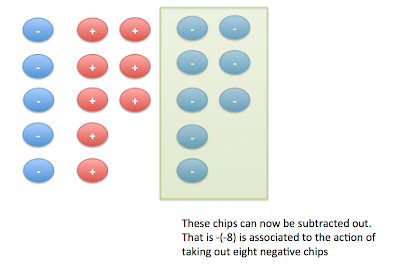
D. The remaining chips are used to compute the result of $-5 - (-8)$, which equals 3.

The unit starts with modeling integers with the temperature chips, and progresses to using these with operations and explaining why things work. Part of the unit is presented here.
Temperature Tank Model: A model for the integers is the temperature tank. The tank, when it has zero chips in it is at zero degrees. If you add a PLUS chip, then the temperature in the tank goes up one degree. If you add a MINUS chip, the temperature in the tank goes down one degree.
Instructions: Please model what you are doing on the open number line AND express each situation numerically.
Definition 8 states the zero pair, which is the core idea underlying equivalence of integers.
Problems 9-12 are intended to gently guide students to investigate the idea of equivalence. The instructor has a major role here when summarizing student discoveries. When students discover equivalence, then the instructor can jump in: "Look what you have discovered… We can now express any integer in infinitely many equivalent ways. In mathematics this is the idea of equivalence. Two expressions that are not identical represent the same number..."
Problems 13-16 hit the topic of why subtracting a negative is equivalent to adding.
The unit continues on to hit multiplication, skills, and caps with division concepts (without remainders).
Discussion
Let's break this all down. First, the task of explaining why is a much more sophisticated task compared to ones asking students to "compute the answer to…" In fact, students must put several pieces together: the context, the computation, apply concepts (zero pairs, equivalence), and express all this in writing. My belief is that this is where we want all students to go! It needs to be emphasized that picking big goals is important. It's not just about getting answers and making it through the computation. Students should own the math, and by own the math it is meant that they know how things work, how to compute, why things work the way they do, and be able to communicate their ideas clearly.
Construction of the unit has structural features that are generally present in IBL units. The beginning is usually a collection of starter problems intended to help students become familiar with a context and the basic ideas. In this case the unit starts with representing integers with a physical model.
The logical order of mathematical learning always dictates what happens next. Hence the middle phase varies. In this specific unit, an idea is needed to address the "why" questions later, thus introducing the zero pair is necessary. The middle phase is built off of developing an understanding of equivalence of integers. In general, the middle phase of a unit focuses on lemmas, key concepts, important techniques, etc. that are critical in addressing the major goals of the unit.
The last phase is encapsulated by goal problems or goal theorems. One of the big goals of the unit is for students to be able to justify why subtracting a negative is equivalent to adding. Problems 14-16 are the goal problems, and in fact were the first problems I wrote down for the unit. I start with the goal problems, and then reverse engineered what is needed logically and experientially to form the unit. This takes a bit of time and scratch work to figure out the first time, but over time it gets easier. More and more examples of problem sets (units and entire courses) are being developed by the IBL community, and the need to build materials from scratch will diminish over time.
The components of a generic IBL unit:
In order to hit a wide audience, I've chosen a 6th grade topic, integers. The reason for this choice is that it is one of the content areas that is often memorized, but not understood conceptually. The integers are a mathematically wonderful landscape, and opportunities to explore this landscape are usually missed. Despite the choice of using integers, the core ideas are applicable broadly.
The first step is to survey the learning landscape. I'll focus on subtracting integers, which is where things get really interesting. Typical 6th grader (skill-level) tasks with integers includes subtracting positive and negative integers.
$10-6 = 4$
$4-(-8) = 12 $
$-5 - (-8) = 3$
If I ask a middle schooler (or older student/person), why this work, the vast majority of the time I get, "I don't know. It's just how I was taught to do it." To answer why questions, one needs to understand the notion of mathematical equivalence. Equivalence is a major idea that lies at the heart of the matter, not only for integers, but also in many other areas of mathematics. Equivalence shows up in the integers via the idea that every integer can be represented in infinitely many ways using zero pairs.
$$5 = 5 + (1 - 1) = 5 + (2 - 2) = 5 + (3 - 3) = \cdots$$
Written another way,
$$5 = 6 - 1 = 7 - 2 = 8 - 3 = \cdots$$
An important developmental milestone for young students is realizing that every integer can be expressed in infinitely many different, yet equivalent ways. This idea then allows students the mathematical flexibility of choosing suitable representations to more easily enable them to solve problems and verify why things work.
\begin{eqnarray*}
-5 - (-8) &=& -5 + (8-8) - (-8) \hspace{.5in} \mbox{ (A zero pair $8-8$ is inserted) }\\
&=& [-5 + 8] + [-8 -(-8)]\\
&=& 3 + 0 \\
&=& 3
\end{eqnarray*}
Adding in a zero pair ($8-8$) allows the expression to be rearranged so that the computation can become completed using subtraction and another zero ($-8-(-8)=0$). This explanation is the bare math, so a context is useful to support the ideas for 6th graders.
Temperature is a suitable context, since negative temperature can represent degrees below the temperature water freezes (Celsius). The "Temperature Tank" model, which is based off ideas I learned from Professor John Wilkins, Cal State Dominguez Hills, allows students to model the integers using temperature and counting chips to develop their initial understanding. Contexts are important in school mathematics, because they provide a concrete base to build off of. It's not that all problems have to be real-world based. The idea is to provide a realistic enough situations to provide "handles" to the core ideas, and then let students make the generalizations and abstraction naturally.
Let's see how this works for $-5-(-8)$.
A. The number $-5$ can be represented with five negative chips.


C. Then $-8$ can be subtracted from this expression.

D. The remaining chips are used to compute the result of $-5 - (-8)$, which equals 3.

The unit starts with modeling integers with the temperature chips, and progresses to using these with operations and explaining why things work. Part of the unit is presented here.
Temperature Tank Model: A model for the integers is the temperature tank. The tank, when it has zero chips in it is at zero degrees. If you add a PLUS chip, then the temperature in the tank goes up one degree. If you add a MINUS chip, the temperature in the tank goes down one degree.
Instructions: Please model what you are doing on the open number line AND express each situation numerically.
- The tank starts off with no chips inside it and is at zero degrees. Explain what happens to the temperature of the tank, if you add three PLUS chips.
- The tank starts off with no chips inside it and is at zero degrees. Explain what happens if you add five MINUS chips.
- The tank starts off with 6 PLUS chips and 5 MINUS chips. What is the temperature of the tank?
- The tank starts off with 6 PLUS chips and 5 MINUS chips. Explain what happens to the temperature of the tank if you remove 3 PLUS chips.
- The tank starts off with 6 PLUS chips and 5 MINUS chips. Explain what happens to the temperature of the tank if you remove 3 PLUS chips, and then remove 4 MINUS chips.
- The tank starts off with 8 PLUS chips and 17 MINUS chips. Explain what happens to the tank if you take out 3 MINUS chips.
- The tank starts with 7 MINUS chips in it. Then Francisco adds 3 more MINUS chips into the tank. At what temperature is the tank?
- Definition: A zero pair is a pair of numbers that add up to zero.
- List as many zero pairs as you can, but organizing them into a table. After you create a table of all the zero pairs, explain any patterns you notice.
- How many possible different ways are there to represent using zero pairs the temperature zero degrees? Explain.
- How many different ways can you express the number 5 using the temperature tank? List at least 7 different ways.
- How many different ways can you express the number (-3) using the temperature tank? List at least 7 different ways.
- The temperature tank is at 5 degrees, and you take out of the tank 3 MINUS chips. What is the resulting temperature of the tank?
- The temperature of the tank is -3 degrees. You reach into the tank and take out 4 MINUS chips. Find what the temperature of the tank will be.
- The temperature of the tank is 10 degrees, and you take out 11 MINUS chips. What will the temperature of the tank be? Explain.
- Using the temperature tank, explain why subtracting a negative is equivalent to adding the absolute value of that number. For instance 5-(-7)=12.
- ...
Definition 8 states the zero pair, which is the core idea underlying equivalence of integers.
Problems 9-12 are intended to gently guide students to investigate the idea of equivalence. The instructor has a major role here when summarizing student discoveries. When students discover equivalence, then the instructor can jump in: "Look what you have discovered… We can now express any integer in infinitely many equivalent ways. In mathematics this is the idea of equivalence. Two expressions that are not identical represent the same number..."
Problems 13-16 hit the topic of why subtracting a negative is equivalent to adding.
The unit continues on to hit multiplication, skills, and caps with division concepts (without remainders).
Discussion
Let's break this all down. First, the task of explaining why is a much more sophisticated task compared to ones asking students to "compute the answer to…" In fact, students must put several pieces together: the context, the computation, apply concepts (zero pairs, equivalence), and express all this in writing. My belief is that this is where we want all students to go! It needs to be emphasized that picking big goals is important. It's not just about getting answers and making it through the computation. Students should own the math, and by own the math it is meant that they know how things work, how to compute, why things work the way they do, and be able to communicate their ideas clearly.
Construction of the unit has structural features that are generally present in IBL units. The beginning is usually a collection of starter problems intended to help students become familiar with a context and the basic ideas. In this case the unit starts with representing integers with a physical model.
The logical order of mathematical learning always dictates what happens next. Hence the middle phase varies. In this specific unit, an idea is needed to address the "why" questions later, thus introducing the zero pair is necessary. The middle phase is built off of developing an understanding of equivalence of integers. In general, the middle phase of a unit focuses on lemmas, key concepts, important techniques, etc. that are critical in addressing the major goals of the unit.
The last phase is encapsulated by goal problems or goal theorems. One of the big goals of the unit is for students to be able to justify why subtracting a negative is equivalent to adding. Problems 14-16 are the goal problems, and in fact were the first problems I wrote down for the unit. I start with the goal problems, and then reverse engineered what is needed logically and experientially to form the unit. This takes a bit of time and scratch work to figure out the first time, but over time it gets easier. More and more examples of problem sets (units and entire courses) are being developed by the IBL community, and the need to build materials from scratch will diminish over time.
The components of a generic IBL unit:
- Opening: units open with starter problems, definitions, assumptions, and establishing the context/topic. (Starter problems may need to be interspersed throughout the unit.)
- Middle Phase: the middle phase is the main building phase of the ideas, techniques, and mathematical perspectives. The building blocks should contain the core mathematical building blocks, which are usually found by reverse engineering.
- Goal Problems: the big learning goals of the unit are usually at the end of the unit. The goal problem phase may also include applications.
- Wrap-up: reflecting and organizing what has been learned is highly valuable, and often a good way end a unit. Additional applications for formative assessment purposes to ensure the goals have been met can also be implemented in the wrap-up.
More examples are forthcoming from different levels of mathematics. I hope this post highlights that IBL math is more than just a collection of problems, implemented so that students are required to work on the problems and present them. That captures only a fraction of the IBL framework. Units are composed with a story or narrative, and designed to support a natural arc of learning. Moreover, the units are not fixed. They can be adapted over time, and it is expected that an instructor must add or subtract problems in class to adapt to specific learning needs with each class.
Does this specific unit on integers work? Yes! The unit is not some theoretical prototype I cooked up in the lab. It was designed, implemented and updated from actual classrooms. In fact, the unit has been used multiple times in 6th grade classrooms, where students successfully make it through all of the problems, explaining how and why things work, all the while learning the skills, too. The full unit is posted HERE and HERE. You are free to use it, change it, make it better.
In comparison, a conventional, teacher-centered unit, where mathematical equivalence is not included, usually means that answering why questions is out of reach for students. A conventional framework may include diagrams/schemes (e.g. subtracting a negative is jumping to the right), which is merely a restatement of the rule using the number line. These essentially boil down to, "Here is how to calculate these things, and here are some heuristics to help memorize them." There are many limitations to such a learning arc, and one of the main limitations is not providing students the mathematical foundations for making sense of the fundamental ideas and building viable mathematical arguments to explain them. On the other hand, building upon the bedrock of mathematics, providing entry points for all students, and opportunities to explore, experiment, and explain, gives students a chance to truly own it and develop as young mathematicians.
Believe in your students!
Wednesday, December 11, 2013
Learning from History, Warren Colburn 1830, and the Implementation Challenge
More than 180 years ago Warren Colburn presented his work and ideas to the American Institute of Instruction in Boston, MA, August 1830. It was published in the proceedings, and has been reprinted with permission, by the University of Chicago Press. LINK
(Disclaimer: In this blog post Colburn is quoted verbatim, and as was the style at the time the gender of students or scholars is written as "he" or "him." In an effort to be 100% clear, these are Colburn's words and not mine, and there is nothing implied by me or the IBL community about scholars = male. My own opinion and the viewpoint of AIBL is of course 100% for equality in math teaching and opportunity for all groups. I hope we can instead focus on the ideas presented, and put aside the arcane language in Colburn's address. One hundred and eighty years is a very long time.)
It's a very familiar point. Through Colburn's experiences teaching math (primarily tutoring) and writing his own arithmetic text, he developed keen insights into learning mathematics. Many of the points he made nearly two centuries ago are relevant and warrant thought and investigation by instructors today.
1. A curriculum with appropriate problems suited to the learner is necessary. Problems should start with the easiest problems first and be logically ordered.
(Disclaimer: In this blog post Colburn is quoted verbatim, and as was the style at the time the gender of students or scholars is written as "he" or "him." In an effort to be 100% clear, these are Colburn's words and not mine, and there is nothing implied by me or the IBL community about scholars = male. My own opinion and the viewpoint of AIBL is of course 100% for equality in math teaching and opportunity for all groups. I hope we can instead focus on the ideas presented, and put aside the arcane language in Colburn's address. One hundred and eighty years is a very long time.)
"By the old system the learner was presented with a rule, which told him how to perform certain operations on figures, and when they were done he would have the proper result. But no reason was given for a single step... And when he had got through and obtained the result, he understood neither what it was nor the use of it. Neither did he know that it was the proper result, but was obliged to rely wholly on the book, or more frequently on the teacher. As he began in the dark, so he continued; and the results of his calculations seemed to be obtained by some magical operation rather than by the inductions of reason."
1. A curriculum with appropriate problems suited to the learner is necessary. Problems should start with the easiest problems first and be logically ordered.
"…choose the easiest [problems] first, and then the next easiest, and so on. And where one things depends on another, make them follow each other as much as possible in the order of dependence."2. Students should be allowed to come to their own conclusions first, even if they are not wholly right. Initial attempts are a necessary component of learning.
"The learner should never be told directly how to perform any operation in arithmetic. Much less should he have the operation performed for him. I know it is generally much easier for the teacher… either to solve the question for him or tell him directly how to do it…. Now by this generally no effect was produced on the scholar, except admiration of the master's skill in ciphering."
"Secondly, when the scholar does not understand the question or proposition, he should be allowed to reason upon it in his own way, and agreeably to his own associations…. it is the best way for him at first, and he ought by no means to be interrupted in it or forced out of it."
3. Success breeds confidence.
"Nothing gives a scholar so much confidence in their own powers and stimulates them so much to use their own efforts as to allow them to pursue their own methods and to encourage them in them."
4. Understanding student thinking is a critical component of effective teaching. Teachers should be able to trace the logic of students so as to inform their teaching.
"…it is very important that a teacher should be able readily to trace, not only his own associations, but those of all his pupils, when he hears them recite their lessons. When a proposition or question is made to a scholar, he ought to be able to discover at once whether the scholar understands it or not."5. Exposition (presentations) should be a regular part of class, and as developing the ability to communicate is highly valuable.
"It is chiefly at recitations that one scholar can compare himself with another; consequently they furnish the most effectual means of promoting emulation. They are an excellent exercise for the scholar, for forming the habit of expressing his ideas properly and readily. The scholar will be likely to learn his lesson more thoroughly when he knows he shall be called upon to explain it."
This is enlightened work, especially given that Colburn had other non-educational interests, and was not primarily an educator. Moreover, Colburn's words are quite alarming for those of us working in education in 2013. The presented ideas provide a mile markers to compare against, and indeed we have known for a long, long time about engagement and learning. Seventy years after Colburn, John Dewey and others proposed ideas to engage students, and efforts continue to this day to update how we teach on a broad level. Despite all this our mission is not accomplished, and classrooms with deep engagement are still in the minority. Hence, evidence supports the notion that implementation is one of the foremost issues in education, if not the most important issue in education.
I am one of many instructors, who believes that finding new knowledge, new ways of teaching, new ways of understanding how students learn, and all that we work for in education can be used to make the world a better place. It is clear that knowing is not enough, and we need to do a better job of informing the public, colleagues, policy makers, and students about what the main issues are and what the balance of opinion is by experts. Teaching innovation is good and necessary, but not sufficient. We are good at innovating in the U.S. We are much less successful at broad implementation of our innovative ideas. Finland, the darling of PISA and international comparisons, imports much of their teaching innovations from american research universities. If only we could more widely implement our own ideas!
To paraphrase Bertrand Russell, are we just mote of dust floating in a small insignificant solar system, or are we what we appear to Hamlet? Or both? We have both the capacity to develop wonderful ideas and wonderful ways to teach them. This is education's Hamlet moment.
The Implementation Challenge: Can we solve the problem of implementing empirically-validated, student-centered teaching methods widely?
I am one of many instructors, who believes that finding new knowledge, new ways of teaching, new ways of understanding how students learn, and all that we work for in education can be used to make the world a better place. It is clear that knowing is not enough, and we need to do a better job of informing the public, colleagues, policy makers, and students about what the main issues are and what the balance of opinion is by experts. Teaching innovation is good and necessary, but not sufficient. We are good at innovating in the U.S. We are much less successful at broad implementation of our innovative ideas. Finland, the darling of PISA and international comparisons, imports much of their teaching innovations from american research universities. If only we could more widely implement our own ideas!
To paraphrase Bertrand Russell, are we just mote of dust floating in a small insignificant solar system, or are we what we appear to Hamlet? Or both? We have both the capacity to develop wonderful ideas and wonderful ways to teach them. This is education's Hamlet moment.
The Implementation Challenge: Can we solve the problem of implementing empirically-validated, student-centered teaching methods widely?
Monday, November 25, 2013
IBL is Fun!
Something that doesn't get talked about enough is how much fun it is to teach via IBL, when things are working well. At workshops and conferences we focus on the benefits to students and the benefits to learning. We bring out research papers from the education research literature, and discuss the benefits of active, student-centered instruction. All these are appropriate and clearly the right thing to do, since there is evidence from literature on K-12 math, K-12 science, K-college non-STEM subjects, research on how people learn, and undergraduate STEM fields. The evidence from a variety of sources, across subjects, through a long time span, and across education levels points in the same direction. That's the argument from the scientific point of view. But is it fun? The answer is undoubtedly yes!
IBL is fun!
Note: We'll have more posts in the future showcasing the transformative experiences students have had. These experiences have not be capture in research papers yet, and we are collecting videos of students who can share their experiences in IBL classes. These videos hit on "IBL is fun" and how rewarding it is professionally to be able to create a classroom culture, where such things are possible.
One aspects of IBL teaching that gets overlooked in our efforts to be careful and scientific is that at a basic level IBL courses are fun teach (when it's working well). You get to be the mentor in the middle. Students, who are initially tentative start to open up. They do more, they show more, and then there are those special moments when you see students realize that they can be players in the game. They enter the fray, respond, and contribute.
One of the great experiences as a teacher is working with students as a team with the goals of becoming better, smarter, and more knowledgable. That's a wonderful process to be a part of. Working with the students,... coaching, mentoring, celebrating the successes, getting through the brick walls, and seeing the development over time is highly rewarding. The growth mindset is something you can see, and when the growth-mindset light bulb turns on, and you were there to be a part of it… that's magic! That's what makes it worth all those nameless late Tuesdays nights, grading, mulling, thinking of what to do next... We might ask what this is all for? And then you see the results, stand back, and smile.
One of the great experiences as a teacher is working with students as a team with the goals of becoming better, smarter, and more knowledgable. That's a wonderful process to be a part of. Working with the students,... coaching, mentoring, celebrating the successes, getting through the brick walls, and seeing the development over time is highly rewarding. The growth mindset is something you can see, and when the growth-mindset light bulb turns on, and you were there to be a part of it… that's magic! That's what makes it worth all those nameless late Tuesdays nights, grading, mulling, thinking of what to do next... We might ask what this is all for? And then you see the results, stand back, and smile.
IBL is fun!
Note: We'll have more posts in the future showcasing the transformative experiences students have had. These experiences have not be capture in research papers yet, and we are collecting videos of students who can share their experiences in IBL classes. These videos hit on "IBL is fun" and how rewarding it is professionally to be able to create a classroom culture, where such things are possible.
Monday, November 18, 2013
Active vs. "Active"
Not all active classrooms or activities are forms of IBL teaching. The nature and quality of active learning experiences can differ widely among instructors. In fact, two people saying they implement active, student-centered instruction can be as different as it gets, where one is essentially a traditional instructor and the other on the full IBL side. For instance using handouts/worksheets in class can be implemented in a vast array of different ways from low engagement in memorizable procedures to true mathematical investigations and discoveries. How active learning is implemented matters greatly.
We can highlight the differences between truly engaging active classes from those that have the veneer of active learning in several ways. In this post, how instructors ask questions is highlighted as one area where differences can be seen. The quality of the questioning by an instructor says much about the active vs "active." Below are two examples, set in a calculus context, but the specific context can easily be from any math course.
Example 1: Instructor A asks students, "What is the derivative of $f(x)=x^{3}$ at $x=2$?" Pause. A student volunteers, "12" "Good!"
In the first example, Instructor A asks a simple question that has a numerical answer. If the answer is correctly stated by someone, the instructor may feel that the students can do the problem. An untrained observer would think all is well and that this is an example of active learning. The teacher asked a question and received the correct answer from a student. All good, right? Well, not so fast. I think we can do better. This is essentially a closed process. Once the answer is given, it's time to move. Instructor A may ask, "Are there any questions?" but that question has lost much of its value in math classes today.
Example 2: Instructor B asks students, "Take a moment to find the derivative of $f(x)=x^{3}$ at $x=2$, and check with your neighbor… [Instructor B selects a student using some method to distribute evenly who gets called on]. Linda, would you share how you did this example?… Thank you!"
In the second example, Instructor B asks a student to explain how she went about the problem, hence encouraging a discussion of the important aspects of a computational problem. The focus is on the process, and the answer is a component of the discussion. Based on the response, Instructor B can restate Linda's ideas, ask follow-up questions, ask another student if he/she agrees, and so on. It's a discussion that is open-ended.
These two examples are based on a basic, computational task. Greater distinctions in questioning and ensuing discussions exist when topics become more sophisticated, which highlights the importance of asking good questions.
Let's go back to example 1 to see what else we can learn. Asking a question to the class and waiting for volunteers usually leads to the situation where only a handful of students regularly contribute to the discussion. Hence a related trap to conventional questioning strategies is that it may only encourage a few students to participate.
Another potential trap for instructor A is reluctance to give harder questions in class or at least discuss them in class, due to the fact that many questions do not have simple, succinct answers. If instructor A seeks quick answers (for the sake of time), then it limits the level of the tasks presented to students. While issues like time and coverage play a role, it is a limited framework for learning if the hard material is covered by the instructor and the students are left with the easy material here and there.
Let's push this idea further and consider a more involved task related to Calculus 1. The task is "Find the equation of the tangent like to $f(x) = \sin (x)$ at $x =\frac{\pi}{4}$." It is likely that some (many?) calculus 1 students would get stuck on some aspect of the problem, at least for a short period of time. Such a task would not be given to students as a quick answer question, since it involves several steps, so Instructor A is more likely to demonstrate it, because "it's too hard" or "takes too long."
We know from math education research that the twin pillars are (a) deep engagement in rich mathematical tasks, and (b) opportunities for students to collaborate in some form. Collaboration is defined broadly, where collaboration can mean anything from pairs to small groups to specialized whole group discussions (i.e. pure Moore Method presentations.) Instructor A achieves neither of these goals through the style of questioning employed.
Engaging students requires a different skill set compared to making clear, lucid presentations, and starts with effective questioning. Here are some examples.
We can highlight the differences between truly engaging active classes from those that have the veneer of active learning in several ways. In this post, how instructors ask questions is highlighted as one area where differences can be seen. The quality of the questioning by an instructor says much about the active vs "active." Below are two examples, set in a calculus context, but the specific context can easily be from any math course.
Example 1: Instructor A asks students, "What is the derivative of $f(x)=x^{3}$ at $x=2$?" Pause. A student volunteers, "12" "Good!"
In the first example, Instructor A asks a simple question that has a numerical answer. If the answer is correctly stated by someone, the instructor may feel that the students can do the problem. An untrained observer would think all is well and that this is an example of active learning. The teacher asked a question and received the correct answer from a student. All good, right? Well, not so fast. I think we can do better. This is essentially a closed process. Once the answer is given, it's time to move. Instructor A may ask, "Are there any questions?" but that question has lost much of its value in math classes today.
Example 2: Instructor B asks students, "Take a moment to find the derivative of $f(x)=x^{3}$ at $x=2$, and check with your neighbor… [Instructor B selects a student using some method to distribute evenly who gets called on]. Linda, would you share how you did this example?… Thank you!"
In the second example, Instructor B asks a student to explain how she went about the problem, hence encouraging a discussion of the important aspects of a computational problem. The focus is on the process, and the answer is a component of the discussion. Based on the response, Instructor B can restate Linda's ideas, ask follow-up questions, ask another student if he/she agrees, and so on. It's a discussion that is open-ended.
These two examples are based on a basic, computational task. Greater distinctions in questioning and ensuing discussions exist when topics become more sophisticated, which highlights the importance of asking good questions.
Let's go back to example 1 to see what else we can learn. Asking a question to the class and waiting for volunteers usually leads to the situation where only a handful of students regularly contribute to the discussion. Hence a related trap to conventional questioning strategies is that it may only encourage a few students to participate.
Another potential trap for instructor A is reluctance to give harder questions in class or at least discuss them in class, due to the fact that many questions do not have simple, succinct answers. If instructor A seeks quick answers (for the sake of time), then it limits the level of the tasks presented to students. While issues like time and coverage play a role, it is a limited framework for learning if the hard material is covered by the instructor and the students are left with the easy material here and there.
Let's push this idea further and consider a more involved task related to Calculus 1. The task is "Find the equation of the tangent like to $f(x) = \sin (x)$ at $x =\frac{\pi}{4}$." It is likely that some (many?) calculus 1 students would get stuck on some aspect of the problem, at least for a short period of time. Such a task would not be given to students as a quick answer question, since it involves several steps, so Instructor A is more likely to demonstrate it, because "it's too hard" or "takes too long."
We know from math education research that the twin pillars are (a) deep engagement in rich mathematical tasks, and (b) opportunities for students to collaborate in some form. Collaboration is defined broadly, where collaboration can mean anything from pairs to small groups to specialized whole group discussions (i.e. pure Moore Method presentations.) Instructor A achieves neither of these goals through the style of questioning employed.
Engaging students requires a different skill set compared to making clear, lucid presentations, and starts with effective questioning. Here are some examples.
- Could you explain how you got the answer?
- Could you explain how you thought about the problem?
- Talk to a neighbor for a moment and come up with two comments or questions.
- Could you explain Linda's strategy to your neighbor/the class?
- Consider alternative strategy ABC, and determine if it will work on the previous problem? Think for a moment, and feel free to discuss it with someone... Now I'm going ask a few students to share their thoughts…
Instructors can self assess quickly, by reflecting on what kinds of questions they ask and how these questions are implemented. Such self assessment is useful and can lead to big changes in the positive direction.
Friday, November 8, 2013
A Characteristic of IBL Teaching: Mediating the Interaction Between Students and Mathematics
A question that comes up frequently is, "What are some of the main features of IBL teaching?" One of the main characteristics of IBL teaching that I'd like to highlight in this post is mediating the interaction between students and mathematics.

Education is full of monikers for active, student-centered teaching. We say things like, "Guide on the side," "Mentor in the middle," "Coach," etc. These are nice ways to think about the nature of IBL teaching, and it's important to unpack what these things specifically mean.

Education is full of monikers for active, student-centered teaching. We say things like, "Guide on the side," "Mentor in the middle," "Coach," etc. These are nice ways to think about the nature of IBL teaching, and it's important to unpack what these things specifically mean.
In IBL Math there exists a particular role for instructors, which is to set-up and mediate the problem-solving process. Students are engaged in exploring the mathematical landscape via well-chosen, logically ordered sequences of problems. As students engage in their explorations, the instructor works to support the class so that students' interactions with the mathematics results in learning.
Here are some ways IBL instructors mediate the interaction between students and mathematics. Instructors
- design/adapt appropriate curriculum. The problem sequences must be matched to the goals of the course, must be logically consistent and coherent, and meet the needs of the specific students in the class.
- keep students going without getting overly stuck. That is, struggle is good if the struggle is fruitful. Being stuck is part of the learning process, and students come in with a "tolerance threshold" for being stuck. It's important to stay within these tolerances so that students stay in the game. One positive outcome of an IBL course is that tolerance for being stuck can increase. It's something that can be improved upon.
- provide scaffolding. This idea is related to the previous point is being able to control the "being stuck phases" by offering "bread crumbs" (hints, lemmas, sub problems, deploying group work, etc.) in just the right type and size to keep the cognitive level of the task high, while simultaneously avoiding student shutdown due to being overly stuck. This is where calibrating to specific classes comes into play, and making good choices depends on having good data about students. Listening, observing, and interacting regularly with students forms the foundation of this piece. With good data in hand, it's often clear what scaffolding is needed. "Oh, students are having trouble thinking about supremum. Students may need to work on a couple of problems about upper bounds…"
- set the class structure and environment for positive discourse. Class presentations are of no value if the class environment is not setup appropriately. IBL instructors set the roles, expectations, and procedures of class discourse, which is used to share and validate ideas. The ethos of the class must include inquiry, discovery, mutual respect for students and learning, and valuing "mistakes" as important discoveries.
- provide structure of the material being covered, so that students know where they are in the mathematical landscape. This is an excellent place to inject small lectures and/or organizational tasks, where students are not necessarily solving new problems, but organizing the information they have recently studied.
The central focus is on the math and how students are working on the math. The first major component is creating problems that guide students through the mathematical landscape. Deploying these tasks determines the nature of the interaction students have with the mathematics. As students work on solving problems, help or direction is needed. The instructor provides enough assistance to keep students in the learning zone, without taking away all of the fun and exploration. When students make progress and discoveries, the instructor provides a forum for the ideas to be shared, vetted, and learned by all.
This is the notion of mediating the interaction between students and the mathematics. It is a central component of effective IBL teaching, and a healthy perspective for instructors to embrace.
This is the notion of mediating the interaction between students and the mathematics. It is a central component of effective IBL teaching, and a healthy perspective for instructors to embrace.
Related Posts:
Tuesday, November 5, 2013
AIBL YouTube Channel
Videos from the 2013 Legacy of RLM/IBL Conference have been uploaded to the AIBL YouTube Channel. You can find all of the sessions from the conference HERE.
David Pengelley's Closing Plenary Talk
Subscribe to:
Posts (Atom)