Tuesday, March 27, 2018

Interview: Professor Gulden Karakok


This blog post is an interview of Professor Gulden Karakok, University of Northern Colorado. Professor Karakok works in math education and also facilitates IBL Workshops. Thank you, Prof. Karakok for sharing your insights!

Tell us about your institution and what the teaching environment is like, what courses you typically teach.
I work at the University of Northern Colorado at the School of Mathematical Sciences. Our university started as a State Normal School to train teachers in the area, in 1890s. Since then it is known for educating future teachers in the area, especially the future elementary teachers.  (Here is a short history, if interested: http://www.unco.edu/president/unc-history.aspx)

Our department offers a Bachelor of Science degree in mathematics in three different emphasis areas: a Secondary Teaching, a Liberal Arts, and an Applied Mathematics, and most of our undergraduate students are part of the secondary teaching emphasis. We also offer a Ph.D. in Educational Mathematics, but different from many other math departments that offer Ph.D in Math Ed., we do not have a competing Ph.D. program in Mathematics. We have 6 mathematics education professors in the department (the ratio of math educators to other faculty members is 1:2). I guess the point I’m trying to make is our department focuses a lot on good teaching and our programs are geared towards that aim. 

The courses that I typical teach are mathematics content courses for preservice elementary majors, introductory linear algebra course (we have only one linear algebra course) and graduate level mathematics education courses. I was the course coordinator for the first two mathematics content courses for elementary majors for six years overseeing 10 to 12 sections each semester. Together with course instructors (i.e., faculty members and many graduate students) each semester, we designed and/or revised many activities; which was a great collaborative process. In addition to teaching such courses, I also run Math Circles for middle school teachers and local 4th-8th grade students monthly. 

How do you implement IBL?
Let’s say you walked in to my classroom at a given day, you will see students working on a task in small groups. I typically have students work on a problem or a set of questions in small groups and then present or discuss ideas/approaches/solutions etc. We usually end with a wrap-up whole class discussion, which can look very different each day. As students work on tasks in their groups, I walk around to assess what students are thinking, check to see if they are stuck, challenge their thinking by posing questions and make sure that each individual student is “doing” mathematics. Also, I make decisions on if we need to have a whole-class discussion on certain problematic ideas or if we need to present approaches that are seemingly different to make connections among ideas. I do not necessarily have all students present the same solution/answer, rather try to orchestrate presentations to tease out important mathematical ideas and make connections to the learning objectives of the activity or the course, in general. This working in small groups requires attending to your students’ thinking and progression as well as  decision making on your feet in the moment. It can be very exhausting, especially when you are teaching a new course. 

What are some of the benefits of IBL to your students?
I think the most important benefit for the students is that they “do” mathematics instead of watching some else do it for them. They get their hands “dirty”. On the first day I tell my students that I’m not a selfish person and won’t take away the joy of doing mathematics from them- they laugh, but they slowly understand what I mean as the semester progress. I think having them actively work on mathematics empowers them and gives them the ownership in their learning.  Here is a quote from one of my students:

“I thought it was so funny cause after my meeting yesterday with Dr. G. I went back to my dorm room and all my suitemates were like, ‘How did it go?’ And I was like, ‘My life has changed. I understand math.’ And I was just like freaking out and I busted out the three pages of the portfolio…We worked on stuff and it was weird that I understood because she didn't even tell me what to do, she made me do it myself and figure it out myself. And I thought that was weird because usually, like teachers in high school would be like ‘Oh, yeah, this is how you do it. Now go work on it yourself.’ But she was pushing me to think and try to find the process of how it works. And when I did it... I think that was why I was like so excited, because I figured it out myself, with help obviously, but it was my own thinking.”

Well, this approach of teaching is beneficial to me as the teacher because I can know where my students are in their development of mathematical ideas sooner than later. This (information) allows me to adjust my lessons and provide better learning opportunities for students.  We can skip some materials and focus on other areas as needed.


How did you learn to teach via IBL?
My first IBL teaching method was through the Emergent Scholars Program training that I attended one summer at the UT Austin. When I was a graduate student at Oregon State University, I was selected to run a recitation section for Calc 3 course in this ESP format. With a couple of other graduate students we attended the training during one summer.  I believe the ESP was created by Uri Treisman, connecting to his research work at UC Berkeley in calculus courses. So, the main idea was to create different, challenging tasks for students in our recitation sections for students to work on in small groups. Overall, I got excited to create tasks that were different from the textbook end of the chapter ones. Students were also excited because these tasks were allowing them inquiry into deeper mathematical ideas. After that experience, I worked in another project to create STEM activities and also run sessions using these activities. During this project and in many other projects, my advisor Dr. Barbara Edwards, Dr. Corinne Manogue (in physics) and Dr. Tevian Dray provided me opportunities to develop my teaching style. I’ve been so lucky that they allowed me to develop activities, observed me teach and gave me very helpful suggestions. 

What are your future teaching plans? Aspirations?
As a course coordinator, I have been trying to work with graduate students to give them similar opportunities that I had in my teaching as a graduate student. However, I was doing so many different things as the course coordinator and I did not spend enough time in coaching graduate students in their teaching. Hence, this is my future teaching plan - providing support to graduate students in teaching. This semester I’m teaching one credit seminar course for graduate students on teaching. We have been reading the MAA IP Guide, and discussing what they can implement or are already implementing in their classrooms. Their first assignment for the first week of classes was to read blog posts (e.g., Dana Ernst’s blog and the Discovering Art of Mathematics blog) about what to do during first week/first day and implement one idea in their class and reflect on how it went. I’m so excited that they are enjoying this experience and I love observing their class to see how great they are in their teaching. 

Anything else you want to add?
I’m not sure if such a teaching scholarship exists, but it would be great to spend a semester or a year to observe and/or co-teach with others to learn more about others’ great teaching practices. Such scholarships or fellowships would be great to spread what others are doing their classrooms to improve the learning of mathematics for others.

Tuesday, January 23, 2018

Iceberg Diagram: Fixed-Mindset, Math Anxiety

When students say something like, "I don't learn this way...", it may be the tip of an iceberg. A sign that math anxiety and/or fixed mindsets about learning math lurks underneath the surface. Unless you know the student really well, you may not know the size and depth of the issue. Most people don't go around campus telling others about their math anxiety and fear of failure. Instructors often learn about these things indirectly through more subtle ways.

Here's the Iceberg Diagram


"I don't learn this way..." and "I need to be shown the steps..." are two commons ways to detect an iceberg. Some students may not verbalize these things at all, which highlights why it is important to visit with students regularly and discuss with students about how they are doing with the math task at hand. The more comfortable students are at asking you questions, the better you can hone in on this issue.

Stereotype threat, poor attitudes that do not support learning (i.e. non-availing beliefs), believing mistakes are bad, not realizing hard work is an ingredient of success, and so on. These are things that students have picked up along the way, possibly starting as early as elementary school or perhaps from their homes or elsewhere, and they bring them to your class. These beliefs lie beneath the surface, and ultimately hold some students back.

What can we do? 
There isn’t an easy fix, but we can do something to help melt the iceberg. A broad approach provides the most options and angles of attack. First, problems that are pegged at the right level are necessary, including problems that ask students to explain why things work. Second, instructors need to be ready to coach students through being stuck, pointing out the advantages of productive struggle, including spending time on student buy-in. Third, assessments should also measure process, not just getting the right answer. Fourth, active learning environments that allow all students to ask questions (not just the vocal 3 to 5 in each class), and also regular opportunities to discuss with one another rich mathematical topics. Fifth, readings and/or videos about effective thinking and growth mindset are needed to provide other expert insight, who weigh in on growth mindset. If you, the instructor, are the only one saying these things, it might seem to students like you are making things up. But if growth mindset is presented as a widely accepted emergent truth from research across disciplines, then that's a entirely different framing.

With all that you have a set of strategies that hits at the issue from multiple angles.  Let's get back to the main point. We have a model and a way to see the iceberg, and we have a set of teaching strategies that can address the core issues, which is like applying gentle heat to slowly and surely melt the cold ice.


Here's a quote at the end of the term from a first-year student. This is what melted icebergs sound like.
One big thing I learned from the... assignments was how productive failure can be. Your brain actually grows and develops when you fail. This proved to me that it is more about the process of arriving at the answer than it is about actually getting the right answer right away.


Tuesday, January 16, 2018

Setting the Stage by Dana Ernst, Northern Arizona University

Hello IBL community. Here's a short post linking you to Dana's great piece, "Setting the Stage." It's a good way to get started at the beginning of the term thinking about what to do to get your students to be more engaged and build buy-in. http://danaernst.com/setting-the-stage/

Another thing I like to do at the beginning of the term is watch Ken Robinson's Ted talk, "How to Escape Education's Death Valley". It's a nice way to feel a bit more inspired so that you're encouraged to take that next step.


So take a look at some ways to get started on day 1 and on getting pumped up for the rest of the term.

Happy 2018 everyone!


Saturday, December 16, 2017

IBL Workshops 2018

Math instructors are the college level are invited to register for 4-day IBL workshops in summer 2018. I am pleased to announce on this blog three summer 2018 workshops, with details in the link below. IBL workshops are designed specifically for college math instructors, are hands-on, practical, and intended to help participants learn how to effectively implement "big tent" IBL in a target course. Big tent IBL means that the workshops provide a broad framework for participants to investigate and find an appropriate place suitable for their specific needs, built on the twin pillars of deep engagement in rich mathematics and regular opportunities to collaborate (in some form). 

Full details are posted Link to IBL Workshop Info Page

IBL Workshops in 2018
  1. Chicago June 19-22, 2018 at DePaul University
  2. Washington DC, June 26-29, 2018, at MAA Carriage House
  3. Los Angeles, July 10-13, 2018, at Staybridge Suites, Torrance CA
IBL Workshops are arguably the best way of learning to implement IBL methods. Please consider attending and/or suggesting it to a colleague. We hope to see you next summer!

Friday, November 24, 2017

Being Flexible

Good teachers are above all flexible. This is one of those sentences that's easy to say and hard to live by daily as a teacher. What I mean by this is that when we are teaching a class with real students and dealing with the real-world ebbs and flows of a class, it's pretty hard to be flexible, while sticking to the goals and vision of our courses. And when people tell us to be flexible it's kinda like someone telling us to "chill out" or "relax!" Setting our emotional reactions aside to such comments, what can be do? What does "being flexible" mean anyways?

What I'm going to do is narrow in on a small slice of this topic and look at this pragmatically for teaching. The main idea in this post is giving ourselves room to be flexible.

A common (but not the only) situation that causes tension is when faculty find that their students need more time on a topic AND things are going slower than the scheduled plan. We all get in this situation, no matter how well we plan. So we needed to get to the end of section 2.4 today, but students have questions, which takes time.

Tension comes from the fact that we have a plan and a syllabus and we need to "cover" a prescribed set of materials. If we go too slow, we won't hit our mark. It's like the feeling of being late for a flight. When we are behind schedule, it can feel stressful. If we view teaching through the lens of information transfer, then getting behind means we are not achieving our goals as teachers.

Let's zoom out for a bit. Our attitudes and perspectives about this situation matter. When students have questions that is a good thing. They are curious and letting us know that they need help. That's the point of school. They are here to learn, and they have arrived a point where they need help and letting us know about it.

If instead we view teaching through the lens of maximizing learning, then we can view the slowing as a signal that important learning opportunities have arrived, and the time spent now will be highly productive. With this teacher mindset, then we can create mental room for being flexible.

Mental room for flexibility means it's okay for students to get stuck, and it's okay to be off schedule or script (at least for the time being). If we take this a step further and build in the ability to be flexible when needed some of the time, then we're capable of staying on schedule while still having the flexibility to address the necessary speed changes in learning. Learning is nonlinear.

Mental room is not enough. We need to meet the goals and expectations of the course. So how do we balance these competing forces without changing the entire culture of education? One of the obstacles is coverage, and coverage is one of the biggest albatrosses in math teaching. A common sentence I hear is, "I wish I could do that, but I don't have time." That's understandable. I get it, and I'm not suggesting anyone toss their department syllabus aside. A point I want to get to is that we don't have to throw up our arms and give up. We can up our game and plan better to at least make some room to be flexible. For example, not all topics need to given the same amount of time or emphasis. Some ideas are more central than others. Instructors can also learn about certain topics that students typically struggle with and plan for it, and instructors can use flipped strategies to move some topics outside of clas.

A reasonable solution could be as simple as asking students to read a handout or section of a book before class, and using presentation slides to go over the basic ideas, instead of writing them on the board. We can use email to send logistics info instead of the first 5 minute of class time. Now we just set aside 5-10 minutes daily that can be used to add in another activity or spend more time on an existing activity. Multiply by the number of class meetings per term, and that's a significant number of extra activities or time we can get into a course. This is like moneyball (from baseball). The idea is to push small edges in the long run, and does not require a wholesale change in teaching methodology.

Each course has topics that we know are more challenging, and even coordinated courses have syllabi that accommodate for this. These are good spots for incorporating flexibility-time in our classes. It is already understood that students find these topics more challenging. We can plan to have students work on say 4 problems, but be willing to spend more time on the first 2 allowing students to get up to speed. Careful selection of problems and having good starter problems and lead-in problems/questions/prompts that hit on core concepts or strategies can be highly useful.

The above are a couple of feasible examples of how to build in flexibility. We should touch on an aspect of what happens if we aren't flexible. If an instructor regularly gives the impression that slowing down can't be done, then students may get the impression that questions are not valid. While this is certainly not the intent, if students are sitting there with questions and know there is "no time" to answer them, then that sends a message. This message may even feed into minds with fixed mindsets, further reinforcing negative beliefs. (e.g. the attitude"If I have a question and there's no time or importance to address it, I must be dumb...") Is it really surprising then, if we come across students in math classes that are reluctant to chime in and ask questions?

Being flexible isn't about slowing down when questions arise. Being flexible is seeing opportunity in questions and taking advantage of them.  Further it's being willing to use available tools and teaching practices creatively and efficiently to create time for being flexible.

Flexibility is not a reactive teaching idea. To me it is fundamentally a proactive teaching idea, where an instructor's ability to be flexible is largely established before class time. And if we build flexibility in as part of our planning process, then it frees us and more importantly our students to ask, engage, and learn!


Tuesday, September 26, 2017

Grouping Strategies

Hi IBL Community! This is a post on some (but not all) grouping strategies to setup a more equitable learning environment. The main idea I'll focus on in this post is gender. I setup a hypothetical situation of 8 students (2 women, 6 men) to illustrate the point. Few people teach classes with only 8 students, and the point here is to get across grouping strategies that can be scaled up. So 8 isn't really important here. It just makes the diagrams more useful.  The letter W is for a woman, and M is for a man. I know it's not binary. These are the assumptions for this and only this example to help illustrate grouping strategies. Individual personalities of course play a role, and ultimately dealing with individuals is another important layer, which I set aside for this post.

With all that said, let's get into the examples...

Example 1: women are in groups of four, where all the other members of the group are men. This can create an environment, where women engage at levels lower due to being the only woman in the group and all that.

Example 2: One easy remedy is to regroup so that both women are in the same group. This can balance the interactions.


Example 3: Using smaller groups has advantages. Moving to groups of size three or two, enable a situation where one group has two women and one man, and the other groups are all men.


Example 4: When using pairs (which I use often), no one is in the minority.


Caveats: Grouping strategies by themselves are not enough, and we need to remind ourselves that teaching is a system. There does not exist a magic grouping strategy that solves all equity issues. What grouping strategies can do is help set the "physical" environment more conducive to equity. Good, solid teaching must still be present, and the instructor has to be highly aware of what is going on, which personalities need encouragement to speak, and which personalities need encouragement to listen more.

I spend a lot of time on these kinds of details. Attention to details and attention to the big picture are hard to juggle, and requires careful thought and planning. But when classes are working well, when students respect each other as individuals and teammates, then it's completely worth the extra preparation and planning. The best part for me is seeing the team spirit and the community take form, and seeing students flourish!

Saturday, July 29, 2017

The Next 20 Years: Moonshot Challenges in Post-Secondary Math Education and IBL

This talk was presented at MathFest 2017 at the IBL Conference, July 28, 2017. The text is provided here for those interested in the IBL Community Challenges. Please sign up and join the effort by going to www.inquirybasedlearning.org/challenges


Title: The Next 20 Years: Moonshot Challenges in Post-Secondary Math Education and IBL


Good evening!
Hello IBL SIGMAA!
Hello IBL Community!
It’s so great to see you here!


First thank you Alison, Patrick, Susan, Brian, Victor for inviting me to speak tonight to the IBL SIGMAA and the IBL community. It is truly an honor to be here tonight, and thank you for putting together such a wonderful event!


This is a picture called Moonrise Carrizo Plain
Moonrise Carrizo Plain, Stan Yoshinobu
“Glory lies in the attempt to reach one’s goal and not in reaching it.” - Mahatma Gandhi


Tonight I share with you moonshot goals.  We are going to aim high to see where that gets us.  I’m going to share a subset of some big challenges that lie in front of us that I think we can make progress on in the next 20 years


Before I share some moonshot challenges for the next 20 years, it’s time to think about how we got here and the past 20 years.


I personally have many people to thank...  Ed Parker, Carol Schumacher, Bob Eslinger, Sandra Laursen, Bill Jacob, Ralf Spatzier, John Neuberger, Tom Ingram, Ted Mahavier, Bill Mahavier, David Clark, Lee May, Mike Starbird, Albert Lewis, Norma Flores, Harry Lucas, Jr. and so many more…]  All of them mentored, supported or encouraged me, and most importantly made me feel like I was part of this community. I felt welcomed. Never in my professional life have I felt so welcomed. So thank you! Thank you for all you have done for me.


This highlights the importance of community.  Feeling welcomed and receiving support is in my opinion the greatest strength of this movement, and what I am most grateful for.


On that note, let’s extend this thank you to all those in the first generation. All those here tonight, who were at these conferences during the early years. You know who you are. Please stand up…  Stand up!  It’s time we said a proper thank you. Let’s all thank these pioneers for what they have done for us.  


Thank you!  Thank you for your leadership. Thank you for your courageous efforts. We would not be here today without you.  


Carol Schumacher gave a keynote talk at an IBL conference a few years ago about how students find innovative ways to deal with math challenges that we did not envision... It was an inspiring talk about ways of thinking about IBL teaching!  We create problem sets (AKA the bridges), thinking that’s what students might need to reach the learning goals.  And then they go and find their own way to the solutions.


In parallel some of what we have achieved in this community is unplanned and unexpected.  We have done things that few thought would land us here tonight under these circumstances.


I personally have had zero IBL courses in my education, K through PhD.  This movement started in the south.  The only thing southern about me is that I’m from Southern California.  Apparently that’s not the same thing. Yet, here I am, as someone who has been a part of the IBL movement for more than a decade, speaking in front of you tonight.


This actually makes a lot of sense, once you think about it.  Once you go beyond mere surface features, you see that we are all in the same family.  We have shared goals and shared interests.  We have common understanding that authentic learning experiences is what is best for our students. One of the great, transcendental powers of community is to be able to see past the surface and rally around fundamental values.


I’m going to share a few examples of successes you may not have been fully aware of, to further highlight the point of unexpected successes.


In 2006 I was told we would be lucky to have a 3 participants of the first IBL workshop actually use IBL afterwards.  That’s 3 out of 22 participants.  That was nice in a way, because it set the bar low.  I remember talking to Ed Parker thinking “Okay, we can probably get three.”  Well we did much better than that.  Fast forward a decade.  In total when combining all the workshops run by the IBL Centers and AIBL, over 11 years, we have reached more than 500 participants. Our uptake rates are over 70% in the cohorts for the AIBL workshops, which is a tremendous result for faculty professional development.


In just the highlighted in red workshops (2013-15), we had 138 participants, who taught 180+ sections of IBL courses to 4600+ students. This is in just the first year after participants attended a workshop. The impact will continue to grow for this group! That’s just a slice of the success story when it comes to our workshops.


I am going to highlight Sandra Laursen’s work...
“Overall, IBL approaches leveled the playing field by offering learning experiences of equal benefit to men and women, while traditional courses were more discouraging and less effective for women.”


One of the unexpected successes is that IBL can reduce or potentially eliminate the gender gap in Math. You can level the playing field, without lowering the standards.  I’d argue that we’re raising the standards, and are finally creating math courses worthy of women’s intelligence!


The CBMS has urged our profession "to invest time and resources to ensure that effective active learning is incorporated into post-secondary mathematics classrooms."  


I did not expect that CBMS would take this unified stand.  That is a sign of major progress!


Many other unexpected successes were achieved that I don’t have time tonight to discuss.  We value and celebrate all those successes, and we can continue the discussion afterwards.


Thus, it is so critical to suspend disbelief and have a growth mindset about our future in education.  Growth mindset applies broadly.  I often run into the word “can’t” when talking to others about education.  We can’t do this. We can’t do that. Or they won’t approve that…  Let us dream a little, because we can succeed in ways that we may not have imagined. Let’s add the word “yet” to those sentences. We can’t do it yet, and let’s keep working on it.


Let’s talk about the challenges.


Challenge 1 Establish IBL Professional Development Centers Across the Nation
This idea is based on MSRI, but smaller and more agile centers. The focus is on teaching.  Specifically, faculty professional development in active learning and IBL. Professional development is one of the main ways for math instructors to gain the skills and practices needed to be effective IBL instructors. We need dedicated centers, embedded at institutions of higher education, strategically spread across the nation.


Professional development centers can be places faculty go to throughout the year, get help, mentoring, visit classes, study videos, examine course materials, and all that.  Right now we are limited to summers and with soft money. What we have now will not cut it.


Permanent professional development centers can reach thousands of math instructors, and that is the scale we need to be working on. They should be open in that they welcome instructors from elsewhere and have specific programs for any math instructor interested in IBL.


These PD centers should have full-time people, who can continue to improve and expand professional development opportunities, strategies, and assets, that are relevant to their regions. All of us faculty here work on the IBL movement part-time. While that may be a necessity for most of us, there should be some people who can focus on professional development full time. It allows them to solve problems that part-timers can’t.


Currently we are relying on a part-time, volunteer force, with relatively small financial and professional incentives to carry out this work, dispersed throughout the country, in some cases with little support. Professional development centers would take us to the next level.


The PD Centers are a cornerstone to attacking other big goals, as you will see.


Challenge 2a
Increasing use of IBL methods to more than 50% of postsecondary mathematics courses


The IBL community is well-positioned to help make this happen. We have a community that can support faculty in their efforts to use active learning, and a long, successful track record.


Challenge 2b   
"IBL versions" of Calculus will be the most common form of Calculus
By "IBL versions" I mean that IBL teaching methods are used in the course regularly. We are not necessarily suggesting changes to textbooks. There exist strategies for using IBL that can be adapted to a wide variety of situations, including those with relatively little instructor freedom, where instructors work with the materials given to them.


Textbooks reflect the dominant culture. You don’t change culture by changing the textbooks, and it in fact you might run into more obstacles when you focus on textbooks. My position is that we need to work with people, respectfully and carefully over long periods of time. Then the changes we want will evolve naturally.


Most students don’t even read the book. Let’s think about this… Textbook battles are like arguing over what vegetables to put in your kid’s lunch, when you know they chuck the veggies and eat only the sandwich. Let’s make a healthy sandwich. Focus on the instructors!


A focus on higher levels of instructor skills is a stronger way forward, because those IBL skillsets are generalizable and long lasting. Once instructors go IBL they usually stick with it and expand it.


Challenge 3a
Expand the IBL community by two or more orders of magnitude
This can be done via multiple methods including but not limited to developing IBL consortia, expanding enrollment in IBL Workshops, widespread availability of AIBL Small Grants (or similar), and steady outreach efforts to work with our colleagues in the AMS, MAA, AMATYC, SIAM, ASA, NCTM, NAM, AWM, AIM, the flipped-classroom community, POGIL, Inquiry-Oriented Learning, and others.


I love MAA, and MAA is my home organization, but MAA is not the home organization for everyone, and we need to do the outreach work to bring people into the IBL community.


Fittingly, this is a numbers game.


Challenge 3b
Become a partner in efforts to reform and improve K-12 Math Education
I’ll touch only briefly on this one.  While we are focused on college and graduate math teaching, our work is connected to K-12 math education, and every student’s experience incorporates all levels. It is therefore an obligation to continue to build relationships with our colleagues in K-12 math teaching.


The IBL community has a direct connection to K-12 math teaching via courses for future teachers, our involvement in K-12 professional development, and our shared goal of student success. These connections can open doors for stronger ties, partnerships, and collaborative endeavors.


My belief is that we must engage with humility and respect. Just because we might know more math doesn’t mean we know how to solve their problems and challenges. Going in as a collaborator and a supporter, with open minds, will build more bridges. The main way we can help is by our work in our own classes. HS teachers tell me that one of the blocks or obstacles is that they point to colleges and lecture methods. Some HS teachers believe they are just getting students prepared for college by using the lecture method.


Challenge 4
Inclusivity: Women and minorities are represented in Mathematics proportional to their representation in society.


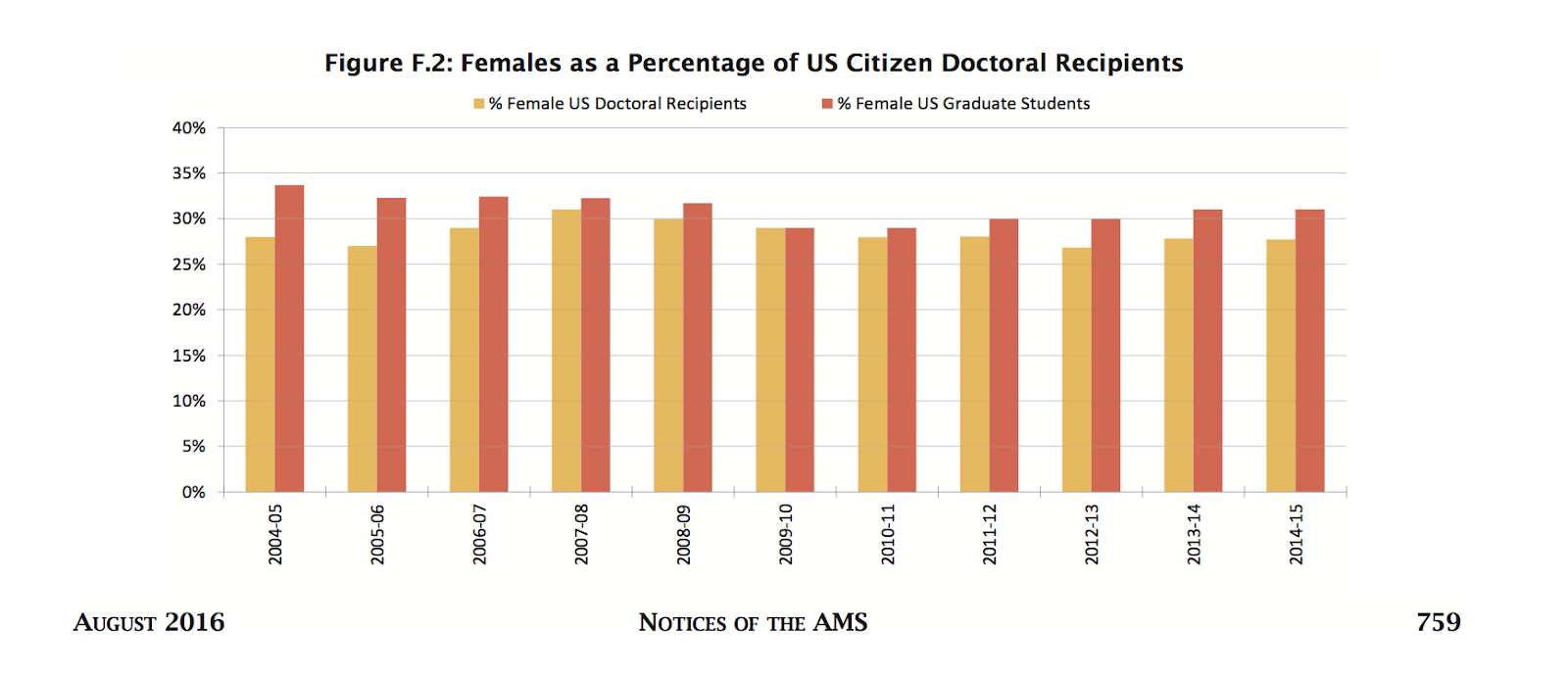
This is a big one and close to my heart. Women and minorities are much more likely to leave the STEM pipeline, and women and underrepresented minorities are not participating in STEM fields and careers at levels proportional their representation in society.  
Female recipients of PhDs in Math hovers around 25-30%.  Referring to the image above, this is not the steady state solution we want. I’m quite frankly tired of looking at this graph.


Where does IBL come into the picture? Research evidence suggests that the IBL framework can help minimize these gaps. Although changing classroom instruction is not enough to solve all of our problems, it is for many students the only opportunity to have a transformative experience that changes the trajectory of their life. It is a place we can start to make a difference, and we can build off of that.  


We have a advantageous position on inclusivity in the IBL community, because our teaching methods have been shown to make a real difference. That’s a good sign. That’s what we needed to hear, and should make you feel optimistic about the future.  There exists a solution and that solution is doable!  We can do something about social justice via effective teaching.


Policy and opportunity matters. So teaching reform isn’t enough. We will need to expand our focus beyond teaching on these issues and become advocates, push for change, and find other strategies we can’t see right now that helps us achieve equity.


Challenge 5 Address Math Anxiety, Promote Growth Mindsets
Math anxiety is rooted in fixed mindsets, poor teaching, and other cultural factors. I hope one day we never have to hear things like "I hate math..." and "I am not a math person..."  


This is a big problem.  It likely affects millions of people. There are 6 million K-12 students in public education in CA.  If 50% have math anxiety, then 3 million students have math anxiety.  That is approximately 24 million K-12 students in the United States.


Teaching growth mindsets, and de-stigmatizing mistakes are two components that can be included in IBL classes. We can once again do something about this via teaching, and we can share our ideas and spread them.


Challenge 6 Informing the general public about IBL
A few years ago when I approached my dean to help with fundraising for AIBL, he said something that really hit the nail on the head. He said that people don’t know about IBL or who you are. It’s hard to raise money for something that no ones knows about.  


Without support from the public, any movement will eventually fade or run into hard limits.  It is therefore our responsibility to inform not just our colleagues, but also the general public about what IBL is, how it helps students, and why it's important for everyone to care IBL. Social media and other avenues exist for us to inform our communities.


7. Other Challenges
This list is a starting point for the IBL Community and how our work connects to larger issues in society. Other challenges exist and are important, and just because something was not mentioned tonight, does not mean that it is not a worthy challenge. And I’ll share how you can put in your two cents in just a moment.  


Courage
Now it’s time to talk about courage. We’re going to need a lot of courage.  


“Courage is the most important of all the virtues because without courage, you can’t practice any other virtue consistently.”
― Maya Angelou


History is full of calls for change in math teaching. The active learning statement by the CBMS is the latest example. The Common Core movement is another. NCTM released the Principles and Standards more than 2 decades ago. John Dewey made calls for engaging students actively about a century ago.  Warren Colburn in 1830, nearly two centuries ago, published an article advocating for engaging students to discover math and think for themselves.  


Math Education has improved over the years, and we have made significant progress. Putting these successes aside for the moment, the calls for change persist. Pure lecture, where teachers do all of the work, still dominates. Fixed mindsets are far too common.


Something powerful binds us, and we are not yet free from these bindings. To change is going to take more than data, or evidence, or a new calculus textbook. Teaching is fundamentally a cultural activity.  We will need to work with people, one-on-one, and do the long work of building and expanding the community. That’s what has been going on here already in the IBL community.  Now the challenge is for us to continue to modernize, evolve, include, and expand our community.


Your courage is needed. Courage to do things that you may not be used to doing. The courage to collaborate when you prefer to work alone. The courage to talk to a colleague, who makes you feel uncomfortable about active learning. The courage to teach using a new method or strategy that you have not used before.  The courage and stamina to stay up late on a weeknight to make changes to your lesson plans, because you know it will be better for your students.


John F. Kennedy said in his Moon Speech in 1962... “We choose to go to the moon in this decade and do the other things, not because they are easy, but because they are hard, because that goal will serve to organize and measure the best of our energies and skills, because that challenge is one that we are willing to accept, one we are unwilling to postpone, and one which we intend to win, ...”


My goal tonight is not only to share my ideas. My main goal is to share the next thing...


I invite you to join us in this work!  


Please go to the AIBL website and sign up to work on these challenges. Click on the community challenges link.  Read the challenges I shared tonight or think of your own.


When you get to the bottom of the page, you can sign up to join the effort. We need you! We need a big community working together. Tell us who are and what challenges you want to work on, and we’ll get going.


You don’t have to wait for the cavalry to show up. You are the cavalry!


You don’t have to wait for the big donors to show up tomorrow. You can take action now with what we have today!


You don’t have to wait for a superhero or a great leader, because there is much more power in a diverse community that is working together.


You don’t have to be a famous person or be a highly experienced expert on IBL. You just have to care, and be passionate about student success.


Just as we invite our students to share their ideas in our math classes, I am inviting you to join us.  Whether you are joining the community for the first time or for the 20th year we welcome you with open arms.


Two years ago, Dave Kung quoted Martin Luther King, Jr. in his keynote sharing with us that the “arc of the moral universe is long, but bends towards justice… and we can bend it.”  That was a powerful message about what we can do as individuals to enact change.


In a similar way I share with you this...
That the arc of the education is long,
But bends towards the bold and hard working.  
We can bend the arc of education!


While we stand here tonight looking out at the distant moon,
We know we got to the moon before,
And watched the earth rise over the horizon.
We can do it again together.  
And we shall do it again together!
Photo Credit, NASA, retrieved from www.nasa.gov


Thank you so much everyone!