Friday, February 26, 2021

IBL Rhythm Changes (IBL-Jazz Analogy)

Rhythm Changes is a common 32-bar chord progression in jazz, originating as the chord progression for George Gershwin's "I Got Rhythm."

Jazz is a useful analogy to some aspects of IBL teaching. You have your big goals and plans for what to do in class, and as the teacher you are the holder of the vision for the course. But what happens in class depends on the people there. Two sections of the same course can often be different on a day-to-day basis. What an instructor does depends on what happened the class before, and being able to "improvise" in the moment to take advantage of what students are saying and doing. That is, be open and able to dance with the spirit. 

The word improvisation sometimes has the connotation that things are just made up on the spot. That's not the case in Jazz improvisation or teaching, and we can unpack what improvisation means. In Jazz improvisation is a studied, practiced, musical art form. Improvisation is within a context, a set chord progression, and there are standard practices and key notes. From these "ingredients" comes the creative artistic part, which I cannot explain and merely enjoy as a fan of Jazz. 

The connection to teaching is that we have our plans for the days and weeks of the course. What happens in a lesson or a specific activity depends on what students do and where they are at. This is where teaching improvisation (or flexibility) comes in. Depending on what a student says, we adapt to maximize the learning opportunities present. Mistakes, half starts, full solutions, alternative takes, are all valued discoveries and items for discussion. The students respond to the teacher, and the teacher adapts to the students. The whole group tries to do math and create learning.

    "In music, silence is more important than sound." - Miles Davis

We can teach using silence, and teaching using silence can mean several different things. One is to ensure students have time to think for themselves. Another is to let students to discuss with one another, where the teacher is not talking and instead listening to student thinking.  A third meaning of teaching with silence is letting problems do the talking. This is when a rich task has the imbedded learning through engagement in the problem-solving process. Rather than the teacher explaining it all, the process of working through a problem can be a way knowledge and skills are learned.

Silence can go too far, of course. A song with 3 minutes of pure silence isn't music. I'm arguing for a balance of saying enough to keep things going or set the stage, but not too much that I'm doing all the playing and students are sitting on the side.  

So what about our detailed plans?  Miles Davis might say, "So what." Plans are preparation, and we should expect to be flexible and present in the moment. Plans are the practice, the setup, the choices about what we're working on, and how we're going to work together. If things go well, our students have the time and space to comp and solo in class, and we learn to work together as an ensemble be more creative, thoughtful, and respectful.

IBL is like Jazz, and one of our jobs as teachers is to be prepared for rhythm changes.


Thursday, January 28, 2021

IBL Workshops Work! Validating Our Theory of Change with the Theory of Planned Behavior (Preliminary)

This blog post is co-written with Dr. Tim Archie, CU Boulder, Ethnography and Evaluation Research, Tim.Archie@Colorado.EDU, and this is work done by him and Dr. Sandra Laursen, Devan Daly, Chuck Hayward, CU Boulder. This effort is funded by collaborative NSF grants DUE-1525077, DUE 1525058.

---

“A lever is a simple machine used to move an object at one location by applying a force somewhere else. When we try something and see that it is working, we have gained leverage on the problem.” -Levers for Change, AAAS Link

In this piece, we look at one of the key levers for change, professional development workshops in higher education. We'll start with our theory of change, and then share results from our research team. Specifically the data is based on participants, who attended intensive 4-day IBL workshops. These workshops provided intensive training to more than 500 college math instructors, impacting hundreds of courses and thousands of students per year. Peer-reviewed articles will be published separately, and if you have questions about technical aspects of this work, please contact Tim. In this piece, we focus on the broad story about how professional development can change instructor behavior in the classroom.

Our Theory of Change is that instructors need professional development to make the switch from passive instructional methods to creating active, student-centered, inquiry-based learning environments.  This professional development must address instructors’ knowledge and skills to carry out IBL in their own classrooms, but also their beliefs about instruction, and must mesh with their own identities as teachers and understanding of their own students and teaching contexts.  Achieving substantive change in teaching can be addressed via intensive summer workshops that provide these resources and a strong, steady support system that follows each instructor through the evolution of their professional career.  Yet we also need to find ways to build the pipeline of instructors who are aware of and receptive to IBL methods.  To widely offer these varied forms of professional development will require a larger, more flexible group of skilled professional developers than is now available.  Building capacity to design and deliver effective professional development is necessary for increasing uptake in college mathematics.

College math instructors are not fully trained in teaching. We may receive some training as TAs, and then we are off to start our teaching careers. Active, student-centered teaching methods, such as IBL, require skills and practices for maximizing effectiveness. While some instructors are able to learn and develop these skills on their own or by attending conferences, professional development workshops can provide a big boost to help instructors new (or newish) to IBL teaching.

The IBL workshop is a 4-strand model. The fours strands are (1) analyzing video of IBL classes, (2) discussing the nuts and bolts of running an IBL class, (3) developing a target IBL course, and (4) studying articles from the mathematics education literature.  The four strands were designed to address specific obstacles instructors face in their classrooms.

How do we know a workshop works? To answer this question, we need to define two terms, IBL capacity, and IBL intensity.


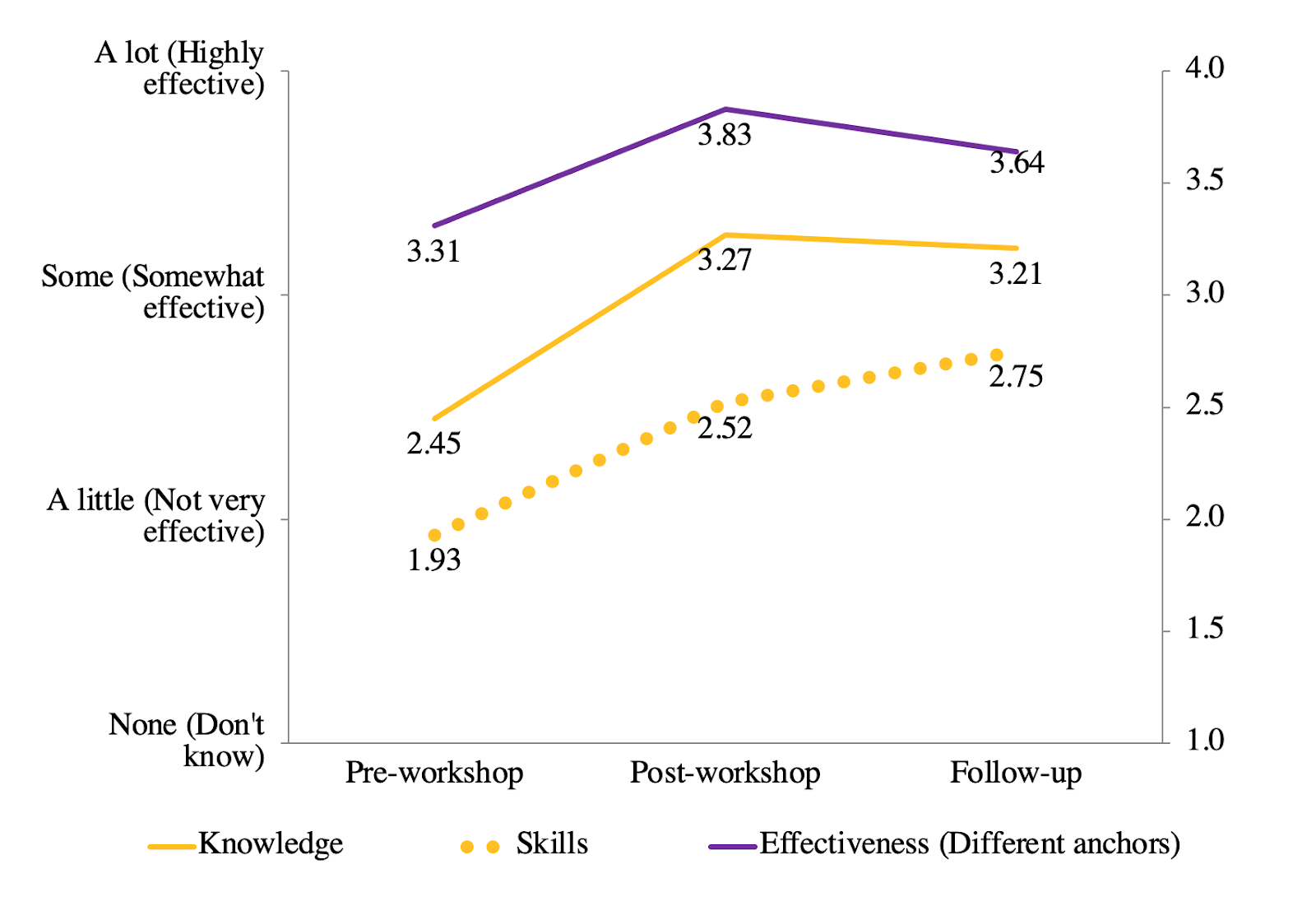
IBL capacity is an aggregate of several variables. It includes a participant’s beliefs about the effectiveness of IBL, knowledge of IBL, and skill in using IBL. What the evaluation team did is ask participants to self-rate their capacity before the workshop, immediately after the workshop and one year after the workshop.


Our data show in the figure below that workshops increase IBL capacity. We see a statistically significant increase in capacity measures from pre to post workshop and that these gains are sustained through to the one year follow-up.


(The slight drop from post-workshop to follow-up is not statistically significant.)


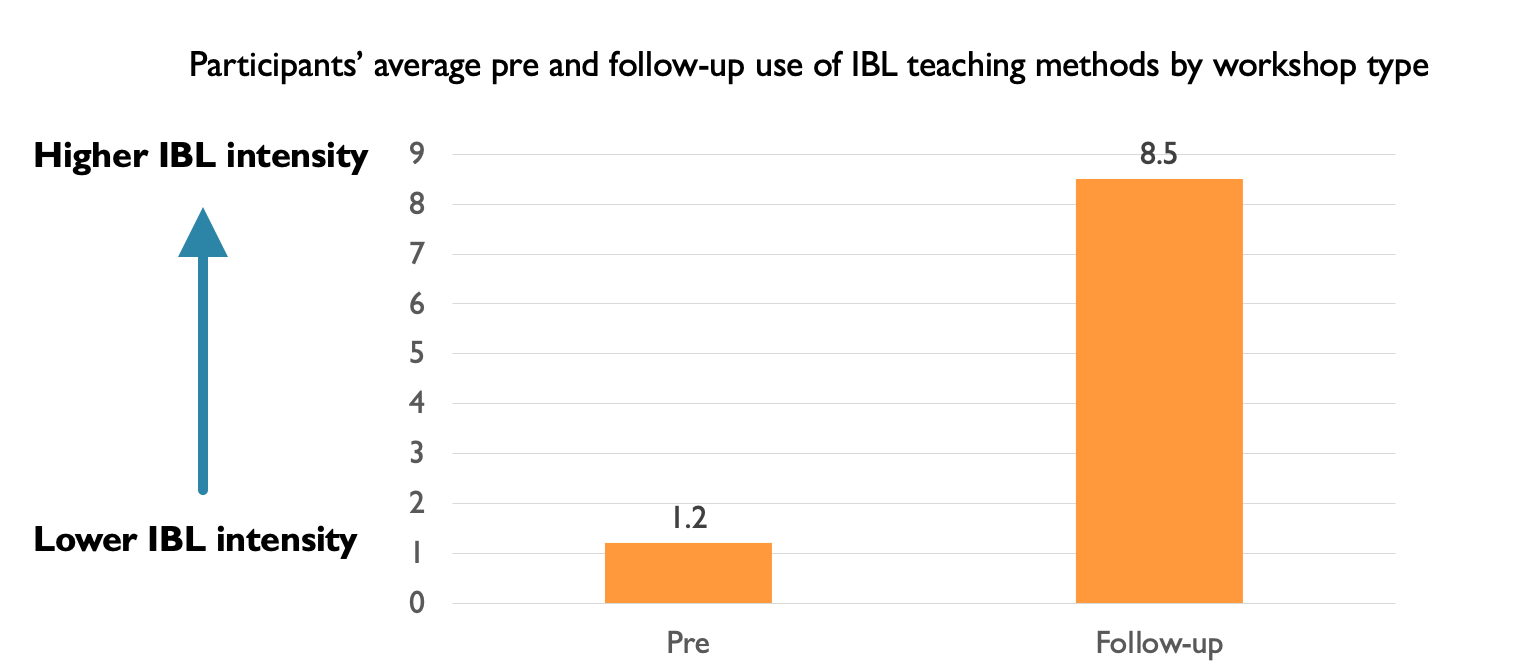
IBL intensity is a way to measure how much or how intensely an instructor is using IBL. We know the workshops are effective because a large percentage of participants, 94%, reported using IBL methods after attending the workshop.  We also asked participants about the frequency of use of a range of teaching practices (e.g. group work, student presentations, lectures, etc.) before they attended the workshop and again one year after they attended the workshop. Higher scores indicate more intensive use of IBL and lower scores indicate lower IBL use.  Based on their responses, we created an IBL intensity scale shown on the y-axis of the chart below. We see a statistically significant increase in IBL intensity from pre-workshop to follow-up.


Crucially there is more to the story on top of the increases to IBL capacity and intensity. The evaluation team also conducted additional analysis to explain more precisely how the workshops work, using the theory of planned behavior (Ajzen 1991). The theory of planned behavior path model explains how the IBL workshops are influential in changing teaching practices and the relationships between IBL capacity, IBL intensity, and some other key factors.


Let's go down the left side of the model. Belief that IBL is effective is a factor that influences teaching. Simply put, the stronger your belief is in the effectiveness of IBL, the more likely you intend to implement IBL, which in turn affects IBL intensity. The IBL workshop has a strand that provides an opportunity to learn about the research supporting the use of IBL, see successful examples of IBL, and learn about real-world stories of student success. 


Subjective norms include factors such as department or institutional support and supportive colleagues.  For instance, the more supportive your department chair is, the higher your intent to implement is, which then affects IBL intensity. Generally, the more supportive the environment is, the more instructors use IBL. Subjective norms can also be a barrier. If you lack support, then you are less likely to implement. Norms matter, because teaching is a cultural activity, and local environments play a role.


The last factor on the left side is perceived behavior control.  This is the perception of how much you control your behavior, which is highly dependent on IBL capacity. If you feel confident in your skills and knowledge how to implement IBL, then this directly impacts both intent and IBL use. This is where IBL workshops play a direct role. Skills and practices are central topics of the workshops, and as shown we have data supporting participant gains in IBL capacity. 


There are other contextual factors that play a role. These factors are prior IBL experience, whether a course is coordinated (in a way that is supportive of IBL), and class size. All of these factors can potentially be barriers, such as coordination that steers instructors away from IBL or large class sizes.  


Factors such as gender, career stage, rank and position, and institutional type do not influence IBL capacity or IBL intensity (i.e. were controlled for).  This is a striking result, because what this means is that anyone can teach via IBL anywhere! While individuals do face different challenges in the field due to their identity, group differences are not detected in the data. Of course identity matters in teaching, but what we know from experience and from data that no matter what group you are in, it is possible to teach via IBL in whatever setting. This means that the challenges we face are surmountable, and the focus should be on finding ways to support instructors.


Technical Question: What does r = 0.18 mean in the relationship between attitudes that IBL works and intent to use IBL? These are standardized regression coefficients which describe the relative strength of association between an independent and dependent variable. Standardized coefficients have standard deviations as their units, making the coefficients comparable when variables have different levels of measurement.  Please also see “An Effect Size Primer: A Guide for Clinicians and Researchers” https://doi.org/10.1037/14805-020


Summary of key findings

  1. The theory of planned behavior model explains 21% of the variability of behavior change (IBL intensity). (Note: R^2 equal to 21% is a significant result for social science. For more see this Link
  2. Workshops increase IBL capacity. 
  3. Workshops increase IBL intensity.
  4. Department norms and institutional support matter for better or worse.
  5. Other factors like class size, course coordination, environment, course coordination, beliefs, play a role influencing IBL intensity. 
  6. Anyone can teach IBL anywhere (under the right conditions)

Consequently, we can confidently say that IBL workshops work. Instructors change practices in meaningful ways. We can measure IBL capacity and intensity, and further we can see more clearly how the pieces fit together in a coherent story. Some policy implications include increased and sustained investment in professional development workshops, providing more support for faculty to access training, conducting outreach by individuals and professional societies, targeted efforts to inform and train department chairs and course coordinators, and investing in addressing institutional barriers to adoption of IBL methods (e.g reducing class size, mitigating the effects of large class sizes).


References

Ajzen, I. (1991). The theory of planned behavior. Organizational Behavior and Human Decision Processes, 50(2), 179-211.


Archie, T., Laursen, S., Hayward, C. N., Yoshinobu, S., & Daly, D. (2020, November 5-7). Findings from 10 years of math instructor teaching professional development [Link to Poster]. This Changes Everything, AAC&U Virtual Conference on Transforming STEM Higher Education.


Ferguson, C. J. (2016). An effect size primer: A guide for clinicians and researchers. In A. E. Kazdin (Ed.), Methodological issues and strategies in clinical research (p. 301–310). American Psychological Association. https://doi.org/10.1037/14805-020


Friday, January 8, 2021

Why I Use Dr. Y or Professor Y When I Teach

When I started teaching, I was given some advice to use my first name with my students. The idea was to be more friendly and make things more comfortable in class. Many of us, perhaps nearly off of us, got that message. I didn’t think about it too hard then, and I did that for many years, all the while not knowing that what I was doing was making things harder for women in academia.

Last month Dr. Jill Biden was the target of a disdainful WSJ op ed, basically saying she’s not a real doctor and full of sexism and anti-intellectual tones. It’s one example of a long history of sexist put down of successful, smart women in the academy.

Men get to be Dr. ___, even if they use Stan or Paul in class, but women get called Ms.___ or Alice, and it’s not always respected or assumed that the woman is a Dr. ___ and an expert.

This is how systemic biases can work. We do things without knowing that it undermines a group of people. A well intended suggestion I received early in my career, which sounded like good advice at the time, actually had some hidden( to me) negative aspects that oppresses women in higher education. Later I learned about the biases that make it so that women have to work harder and deal with more, and the extra challenges and burdens women have to deal with.

Consequently, I decided years ago to use Dr. Y or professor Y with my students. It’s out of solidarity with women and minoritized groups, and it’s with the long-term goal of contributing to shifting norms towards equity and social justice. If we all did it, then that’d be the standard way students would address *all* faculty.

In countries like Japan, all teachers in elementary and secondary schools, professors, medical doctors, other leaders are given the title, “sensei.” It is an honorable title for those who teach or help others in society. Japan is not a society that earns high marks for gender equity, so I’m not trying to say that the term is some magic bullet. Thinking about what sensei means in Japan, however, does provide useful insights. Doctor can mean more than one thing, and we generally lack norms that could help our education system be more inclusive and equitable for women.

The closest thing we have to sensei is professor, although professor has been earmarked as a rank. For those who are lecturers and without a Ph.D., we do not have a professional title. Given all this, I argue that it is appropriate for all college instructors to use the title “professor” in classes, just as sensei is used by K-college instructors in Japan. Words and titles can mean more than one thing, and their meaning can be easily understood in context.

Thus, I invite all my colleagues to consider using Dr. or professor with our students, if you haven’t done so already, because it contributes to shifting norms in a decisively positive direction. We could explain to our students why we are using our titles, and why it’s important to respect all educators for gender equity. Where possible, we can use our titles, identities, and positions at our institutions to level the playing field for women in higher education.

Thursday, January 7, 2021

How much professional development is enough?

This post is a summary of some research findings for a series of workshops we have conducted with NSF PRODUCT. The evaluation team for the project is Dr. Sandra Laursen, Dr. Tim Archie, and Devan Daly, CU Boulder E&ER (Link to work on professional development, link to people). The talk was presented at the Joint Mathematics Meetings on January 7, 2021.

One of the many research questions they studied is, "How much is enough professional development?" 


Some key points:

  • We offered two general types of workshops. 
    • One week, residential or online via zoom summer intensive workshops (IWS). These were 30 hours+ of workshop time with a year of follow-up email mentoring.
    • Shorter traveling workshops (TWS), where two facilitators would travel to a conference or department and offer a workshop that lasted from a few hours to a day or day and a half. 
  • IBL capacity is a measure of skills and practices related to IBL teaching. It's sort of like a battery pack for teaching. More capacity means more skills and knowledge.
  • One result from the analysis is that both formats had a positive and significant impact on increasing IBL capacity.
  • IWS participants implement a more intensive version of IBL compared to TWS participants. 
  • TWS reached a different subset of the teaching population and was effective at increasing interest in IBL. 
  • TWS reaching different subset of teaching population is due in part by outreach efforts to send facilitators to groups that are not doing IBL yet. For example, sending teams to 2-year colleges. The IBL community in math roots in the Mathematical Association of American, which skews toward 4-year and advanced degree granting institutions. Travel funding can be a barrier for IWS, and TWS commitment level is lower. (It's a commitment to spend a week of summer at an IBL Workshop.) 
  • Rather than the dosage analogy, a another analogy is TWS and IWS are different tools, and could be used strategically for different main purposes.  
  • Takeaway: Use TWS to increase awareness, interest, reach new instructors, and get people trying IBL methods.  Use IWS to increase depth of IBL implementation. 


Wednesday, December 16, 2020

IBL Blog Playlist (updated)

A really short post...  I've kept playlist of IBL blog posts organized by topic. Posts go back to 2011, and the idea behind the playlist is to help people find some of the more popular posts, instead of having to dig around. Here's the link:  The IBL Blog playlist.  Take care!

Wednesday, November 18, 2020

The case for love, empathy, respect especially during a pandemic


A global pandemic is raging. Children are stuck in online school, and teachers are struggling under the added weight of teaching online or in unsafe conditions, some who have little kids at home 24/7. Social problems are boiling over. Democratic norms are crumbling, and we struggle to coordinate even basic efforts to bring the pandemic under control. Teachers and students are trying to get through their courses, but with the world upside down. This is the context of education in 2020.  

If that's not enough, stories of schools giving out more Fs during the pandemic are making the rounds. This makes me ask, "What are we doing to be giving more Fs during a pandemic and social crises?" Failing grades are clearly a bad sign, and something is seriously not working. 

When a student is doing poorly, it can be for a number of reasons. If we are quick to judge them, it's really easy to blame the student. It's easy say it's their fault for not showing up or not doing the work. Deficit model sometimes kicks in stronger, and maybe the student just isn't "motivated" or "lacks the confidence" or innate ability. It is easy to judge.  Online or virtual teaching makes it even harder for human connection, and I conjecture easier to be more deficit model oriented.

I remind myself that we are in a pandemic, and there is real pain and suffering out there in all our communities. People are struggling. They may have lost a loved one to Covid-19, or they may be the target of racial, gender or other bias. They may be feeling the weight of poverty, or feel the stress of a family business going out of business. A student could be lonely, sitting in from of computer screen all day, trying to learn in an isolated environment that just feels worse and worse as the weeks go by. 

In reality, we don't actually know any student's full story, and this is especially the case if an instructor uses teacher-centered methods. Sure some students come to office hours and good teacher-student interactions can form in these situations.  But generally speaking, the less students talk in class and the less they feel comfortable talking, the less likely it is that an instructor will have a good sense for who a person is. Even in active learning, it can be a challenge. 

Love, empathy, respect in teaching is a few related things put together. It is a visible inclusivity image to remind us all to be kind and respectful to one another. It's also a way to signal to students, that you care about equity and inclusion, and that all students are welcome.  And yet another way to think about love, empathy, respect is in our attitudes as teachers towards our students as humans. Love, empathy, respect is a mindset of being understanding. This idea is called a strengths based approach. That is, we don't assume that poor performance or lack of engagement is due to some deficit, and instead we start from a position of emphasizing student strengths.

It's not that hard really to get started. It comes down to listening. What I do is listen to students, and try and understand what the situation is. Then work with students to find ways to get them through the challenges. Using practices like active learning and mastery grading puts my course in a better spot to be more compassionate, while being fair to everyone. Giving extra chances to try a problem or assignment, is part of the standard package.

Here's a good story. A student of color named Kim (a pseudonym) failed calculus multiple times. Kim took the class 3 times and failed each of those times. That's three Fs.  Most people would have given up, but she tried a fourth time. I actually had her in a different course (for future elementary teachers) during the same term, and noticed that in group activities and class presentations she did really well. When I learned about Kim's struggles with Calculus, it didn't add up. So I suggested she drop by office hours for her Calculus questions, and when she showed up I listened to her try and explain something to figure out how she was thinking.  I learned how she was approaching Calculus versus the future elementary teachers, and saw how in Calculus she tried to memorize without understanding and would get stuck and not know what to do.  In her other class, she worked from the core concepts first, and then was able to think through to find a solution.  Kim's brain was engaged in entirely different ways.  That was a key moment for her education, because she learned about her own thinking that hindered her progress in Calculus and her thinking that made her successful in her other math class.  Skipping forward several terms, she ended up passing Calculus and taking several more math classes, until she earned enough credits to get a middle school math teaching credential added on to a multiple subject credential. That's a huge turnaround!

This was possible because I started from a position of love, empathy, respect. I made sure I tried not to judge, I listened, and then we found a pathway forward, based on Kim's strengths.  Now back when this scenario happened, we didn't yet have the words, love, empathy, respect. There are other words and descriptions for this idea, and I am certainly not the first nor the best teacher to be a mentor like this. But I think today, if I didn't listen and was judgmental or dismissive, she might not have gotten out of the cycling of failing she was stuck in. In my mind it doesn't take great teacher skill or talent to do this, but rather it's mostly about being starting from a position of understanding and caring. 

Another story is about a student named Jerry (pseudonym). Jerry is a historically successful student, but in the class I had with Jerry, things were very different. Jerry missed classes and assignments. When in class, engagement was low and Jerry was spaced out. Anyways, this is a case where the student would likely be written off. You gotta do the work to pass, right?  Well, hold on. I'll email Jerry and check in... Ok, no response for a while. Ok, maybe I'll chat in person next class to meet outside of class... That worked, I think. Now it gets interesting.

It ended up being the case the student was going through a tough time with health issues. Life was hard, and the student was feeling depressed.  I listened. I did what I could to be supportive, by extending deadlines and put the student in groups with highly supportive and dependable classmates. I also pointed out the long-term possibilities of all the wonderful things that could be done in Jerry's major. We all need hope. In the end, even after a rough start, Jerry was able to finish the course.  Later on, I received an email from Jerry, saying thank you for the support and that it was truly a rough time, and that Jerry had thought about ending life. However, with the support of classmates, my teaching, and other community support, Jerry was able to turn things around. Good teaching can help save lives.

Today in 2020, love, empathy, respect is so desperately needed, by millions of students sitting in their rooms alone on their devices trying to get through school. We have a choice in how we engage with struggling students and in general people in our community. I also know that we are also working at over 100% capacity right now, and we're tired ourselves and it's hard to be even more for others. With that said, we all have a need to know that love is the opposite of hate, that empathy warms over the coldness of apathy, and respect counteracts the disrespect of deficit model thinking. 

Hang in there and stay safe!


Monday, October 26, 2020

Seven Ideas to Help with Reopening K-5 Schools from an Educator Perspective

The focus on reopening has primarily been about health and safety for good reasons. It's a good time for us to add another layer to this discussion, which is to think about how we can improve teaching and other related factors to help reopen smarter.

A typical situation parents might find themselves in is this... Their child is doing math homework on their own, and gets stuck. This is added stress on top of all the pandemic stresses. Dinner needs to be cooked, like is hard as is.  It gets emotional, parents are frustrated, Math feels awful, and then everyone wants to get back to in-person school ASAP! 

I totally get it. For many of us with kids at home, it's been a huge struggle during this pandemic. Juggling parental duties, work, taking care of yourself, it's a tough. We all want to go back to something normal. 

In this post, I share some thoughts about actions educators can take to help improve our situation. This is really important, because we want to make the decision to go back to in-person because spread is low and we have the resources to do it right. We shouldn't be reopening prematurely, because virtual teaching is bad. It puts people in harm's way for the wrong reasons. As of this writing, the US is hitting all-time highs in case counts, hospitalizations are increasing, and the government has literally said it's given up.

What this means for schools is that virtual is going to be a big part of reality for a long time. I don't see a way for us to go back and it's magically 2019. 

Many families can't go back to in person, because they have a high-risk member. They deserve a good education.  Others need to go back, because they have essential jobs. We need space for them.  Little children should be in some form of in-person school (assuming it's safe), because they are so young and it's what they need. Secondary and college students should be largely virtual, because we need to set aside precious space and in-person time for the youngest and neediest. But we can make virtual better, and in some cases much better. 

Caveats: I'll focus on Math, because it is my area. The ideas are generally applicable to other subjects.  Education is an extremely large sector. In California, there are over 6 million students in public K-12 schools. This means that the comments I write here are not going to cover all the cases due to the sheer size and range of scenarios that are present. But there are things we can do to (a) alleviate some of the pain and stress of virtual learning and (b) use better virtual learning as part of a larger strategy to carve out time and space for some in-person learning. 

I'm not commenting in detail about things like masks, coronavirus testing, or other health and safety measures. That's an area of expertise that I have been following closely, but it is not my area of expertise.  

Below is a list of some ideas to help with thinking through reopening schools from an educator perspective.  The perspective I can offer as a professional developer in Math Education is that I see areas where we can improve teaching and learning that have benefits with dealing with the pandemic and can have lasting upside even afterwards. 

1. Prioritize the youngest, neediest tiers of students, teacher safety
The top priority should be to the youngest and neediest students and the safety of teachers. If a child can't read yet, because they are in kindergarten, then zoom isn't the best format for this child.  Further, there are other situations for all grades (K-12), such as students who are homeless, who are not safe at their homes, or have special education needs or other needs. These students need to be on school campuses for their wellbeing.  Hence the priority grades are K-2. And other priority groups can be also be identified and put into this top priority tier.  

As our pandemic situation improves, we can add in more tiers. The tiers are preK-2 and high needs, grades 3-5, middle school, and high school. 

Teachers should be classified as essential workers, and they should be in the early phase of vaccinations. They work with large numbers of people, indoors, for long periods of time. Teachers deserve all the support we can give them, because they do so much for our society. Sick or dead teachers are devastating to schools, just as losing HCW in medical settings.

2. Try to decouple academics, socialization activities, and daycare
This section is about rethinking services provided by schools in a different way.  In 2019 and before, schools provided all three of academic training, socialization, and daycare.  What would help our problem-solving approach during a pandemic is to try and split these three things apart, as much as is reasonably doable. This doesn't mean we won't have overlapping areas with these three areas, but that we don't need to bundle them as all-or-nothing. Bundled, all-or-nothing thinking limits what we might possibly be able to do to help more children and families.

For instance we could have academics taught mostly or completely virtually (depending on the grade tier), have socialization events in person and virtually so that children can learn social skills and just have fun and be kids, and daycare could be provided in smaller group sizes, so parents who can't stay home have safer options.  

For example there are families, where the parents are essential workers and the family has an at-risk member. In-person could be too risky.  Families in this situation are put in a tough spot. Consequently, de-coupling the services schools provide opens the door for more solutions. In this case, daycare could be provided in a small setting nearby, while the children do mostly virtual learning, allowing the parents to work while mitigating risks. 

Secondary school students in virtual learning could do some in-person socializing, such as some organized activities in gyms or outdoor fields to do normal things like hangout with friends and get off of screens for a while. Of course properly distanced, masked, etc. 

Decoupling the three services is a complex task, requiring input from all groups, including parents, students, teachers, staff, and local officials. It'd be interesting to see existing solutions in this area, and my sense is that daycare is the key piece. If parents had good daycare, some safe options for socialization, and virtual teaching was good enough, we'd be in a very different context regarding the pressure to reopen schools.

3. Improve virtual (and in-person) teaching via active, student-centered teaching
This item applies more to older grades and upper elementary. But all grades will likely have to be virtual part of the time.   

So, imagine a world where virtual teaching is fun. Your kids are okay with it, and they are learning. This releases some (a lot?) of the pressure to rush back to in-person school, and gives time for scientists and the government to develop better testing and treatments.  

Good teaching is good teaching, whether virtual or in person. Teaching is a complex system and cultural activity. I can't do it justice in this space. The short version is that we can use active, student-centered methods like inquiry-based learning (IBL) to shift classes to engaging, collaborative spaces.  Uptake of active, student-centered teaching is still low in the US, and this is an area of need, whether or not we are in a pandemic. 

The four pillars of IBL teaching in Math are:
  1. Deep engagement in rich mathematical tasks
  2. Opportunities for regular collaboration between students and with the teacher
  3. Instructor inquiry into student thinking
  4. Instructor focus on equity
These pillars aren't specific to Math, and you can substitute in whatever subject.  On a typical day, roughly 2/3rds of class time should be spent on students doing tasks or engaged in thinking through questions, where students are guided by their teacher to think and discuss math questions, such that the process of answering these questions leads to authentic learning.  

Generally speaking, there exist ways to implement IBL methods in virtual settings that are promising for upper elementary and certainly for secondary. Professional development training for teachers is one way to get these kinds of teaching methods into our classrooms. Younger children need more hands-on learning, hence the need to prioritize bringing them back in the first round. 

More information about IBL is available on the AIBL website and on this blog.

4. No math homework in K-5!  
No matter the teaching methods used, one thing that can be done across the board is to eliminate or significantly change homework. Homework is not shown to help learning outcomes in K-5, and I'd argue that it's not needed everyday in secondary either. 

Homework for points adds stress, and even if students do it, many leave disliking Math due to the accumulation of negative experiences.  When students are asked to do problem after problem after problem without help, all alone, it can really frustrating for students who struggle, and entire families feels this, and just makes them want to go back to in-person, whether it's the right thing to do or not.

Math anxiety is a real issue. Many students carry math anxiety into adulthood. See this post on Math Anxiety Realities, where college students speak about their painful experiences from math classes. Teaching in ways that increases stress is not good for student learning, and sometimes leaves lasting scars. 

The best option is to eliminate math homework for K-5. Just don't do it. Do all the learning together synchronously or in-person where possible. 

For secondary, one option is to assign modernized, optional homework, where students are given handout to read about a math idea, technique, a solution to a problem, looking back at recently completed material just to name a few ideas.  

Another option, and a really easy one to implement is to state a problem or question and provide a detailed solution with an explanation. Ask students to try the problem first, and then have them compare their thinking with the provided explanation. 

5. Use mastery-based grading 
There are many reasons to update assessment. A points system is an extrinsic values framing of grades, which is actually not a good motivator, can lead to inequities, and isn't tied necessarily to actual learning. Students are told that homework is worth X points and tests are worth Y points, and it's all about getting points.  While this has been the standard, it's not as good as a system with intrinsic values framing, such as mastery-based grading. In mastery-based grading, students are given transparent learning goals, and given multiple opportunities to learn them. The focus then is on learning.  

A simple example of mastery grading is to give frequent quizzes/tests, where students are given two possible scores. One is "meets standard" and the other is "not yet."   For problems that students earn a "not yet," they are given chances to retry the problem until they earn a "meets the standard."  Quiz/test questions are centered on students explaining why things work, so that they the emphasis is on critical reasoning and problem solving.  Basic skills and concepts should be practiced in class together with informal assessments to give feedback to students and teachers. This feedback then informs the class whether they should practice more or move on.

Other mastery-based grading systems exist that are more sophisticated and tuned for student learning. The example provided is an easy-to-implement version that is compatible with the challenges and constraints teachers face in a pandemic.  See www.masterygrading.com 

One key potential benefit of mastery-based grading is equity. I'll argue via an example. Suppose student A learns a topic in week 7 and student B figures it out in week 9.  The test is in week 8. Student A get a higher grade than student B, but both have learned the same thing.  Now let's say student A is in a middle class family with parents with college degrees who can work from home, and student B has to work or has parents who are working long hours, and student B has more non-school responsibilities.  In this case, mastery grading would result in the students getting the same grade, because they learned the same things. 

Mastery grading can be bias resistant. That is, it is less likely to penalize the student who has more in life to deal with and/or fewer resources.

In states like California, standards-based grading is already used in elementary schools. Where teachers can further make improvements is to drop timed tests, and use oral exams/interviews and other task-based live sessions to see if students are making progress. All these should allow for retakes after getting support. 

Online proctoring software raises many questions about whether they are ethical. Lockdown, surveillance testing is not morally sound, expensive, and completely avoidable. We can use better assessments that are more humane and aligned with learning outcomes that we value, such as critical reasoning and justification. (See this disturbing account reported on by The Washington Post, where a student asks a proctor if she can *vomit* Link).

6. Cull unnecessary or less important topics, and focus more on core topics
A typical math textbook has a lot of material in it. Most teachers and college instructors will say things like, "There's so much to cover."  This really doesn't have to be the reality and shortchanges time on better, high-level goals such as problem solving and communication.  

In every course, some topics can be covered less intensely, because they are less important or tangential to the main learning goals. Each subject area can be culled down to essential topics using the state standards as a starting point. Culling the list of topics can help teachers and students by giving more time for core topics, which actually matter in the long-run. 

Connecting back to the revised homework ideas above, secondary math teachers can cover less important topics by assigning reading, a video, or a handout for students to read and try something. In this way, students get exposure to additional topics, but it's not taking up valuable class time that could be better spent on larger goals.

The reality is that students use Khan Academy and other resources. Harnessing this for a range of uses opens time and space for educators to hone in on key ideas. 

7. Focus on community solidarity
More than any other time in our lives, we need community. We are living through a global humanitarian crisis, and it affects all of us in many ways.  Thus, building community should be one of the core goals of every class. To do this, some class time can be used to build community on a regular or daily basis. We don't only teach Math (or insert your subject).  We teach students, and they deserve an education that is humanistic, empathetic, and compassionate, especially in time like this. 

Why is building community so important? If students feel disconnected and stop caring about their education or worse their futures, then what's the point of learning how to add fractions or complete the square? Thinking of reopening schools purely and solely as a medical problem is incomplete and possibly dehumanizing or invalidating. Putting humanity first is the right move. 

Even in virtual learning, we can build community. Teachers can do this using chat, breakout rooms, padlet, jamboards, discussions, and others. Some socializing virtually can benefit students, and help them feel more involved connected to their classmates and teachers.  

Sample openers for class are fun polls like "What is your preference (a) oatmeal, (b) toast, (c) cereal?" Or "How many cups of coffee did your teacher need this morning?" Mix it up, have fun, be human and authentic!

Common misconception RE rigor
A common misconception area is that hard equals rigor. This is especially true in STEM subjects, where low grades, lots of homework, and lots of students doing poorly means the class is "rigorous."  The corollary to this is that classes where students do better is less rigorous and watered down.  

All of the suggestions above are not about reducing rigor or lowering standards or "dumbing it down." They are adjusting how we teach or assess to improve learning. It should feel easier, more doable, and more enjoyable, if done right. If a student learns more their grades will go up. That's not a sign of less rigor, it's a sign of student success.  If anything, regressive methods are ironically less rigorous, because many of the exam questions can be solved with google or looked up on Chegg.com. This means AI can do much of the usual tests tests, which is less rigorous than having to explain or justify why something works or doesn't work. 

Colleges messed things up
Colleges should have been bailed out and been virtual. We effectively spent significant "in-person budget" on the tier of students most capable of learning virtually, all the while seeding more outbreaks. Bad policy and planning is directly affecting your school's ability to reopen safely. I won't go into details, but here are some links, if you want to dig deeper.

The coronavirus, poor leadership and being understanding
The pandemic is causing our problems. Let's be clear about this. While we may disagree about how to reopen or what to prioritize, the real problem, the real thing causing us all the pain and suffering is the coronavirus and the mismanagement of the pandemic. We need to acknowledge this and not unfairly blame schools or teachers or superintendents for the predicament we are in. Their job is to educate, not to do infectious disease public health. 

Further, East Asian countries have done a much better job managing this crisis, and they can run their schools close to normal. Lack of national leadership in the US, and a catastrophic lack of empathy have created this Groundhog Day cycle we are experiencing. The obstacles of reopening schools are unnecessary, avoidable, and directly a result of failed leadership. 

Thus, it's important we start from a position of understanding and kindness. Schools are not responsible for getting us into this mess, and we shouldn't place unfair responsibility on schools to get us out of this predicament, especially when many schools lack resources to even meet basic needs even before this pandemic. The predicament is on us as a society. Own it. 

Outro
Other major issues in education need to be addressed eventually on a societal level. Specifically we also need to take more action on inequality, old buildings, overcrowding, poverty, school segregation, lack of or inadequate healthcare, and more, because all these things directly affect our schools and prevent us from forming a stronger, more just society.  These issues overlap with the pandemic and can't be solved with improvements to classroom instruction alone. I mention this to contextualize the broader issues at play and the limitations of focusing on teaching.

What is outlined here isn't attempting to solve all the problems, because many issues are outside the locus of control of educators. With that said, real, practical, implementable actions we can make things a whole lot better right now. 
  1. Prioritize the youngest and neediest
  2. Try to decouple academics, socialization, daycare
  3. Use active, student-centered learning like IBL
  4. No math homework in K-5
  5. Mastery grading
  6. Cull content from course that are not essential
  7. Focus on community solidarity
Stay safe and healthy!